
If you or someone in your family has been struggling with breathlessness or a cough that simply will not go away, you already know how unsettling that uncertainty feels. One of the conditions your doctor may want to rule out is Interstitial Lung Disease (ILD). Getting the right diagnosis is the first and most important step. Dr. Rushi Desai, a specialist pulmonologist in Ahmedabad, performs a full range of ILD diagnostic tests and evaluations to help patients get accurate answers as quickly as possible.
What Is ILD and Why Does Early Diagnosis Matter?
Interstitial Lung Disease is not a single condition. It is an umbrella term for more than 200 disorders that cause progressive scarring of the lung tissue. As the lungs stiffen over time, breathing becomes harder and oxygen transfer to the blood reduces. Some forms, like Idiopathic Pulmonary Fibrosis (IPF), are irreversible, but early diagnosis and treatment can significantly slow the progression.
The challenge is that ILD often mimics other lung conditions like asthma or COPD in its early stages. Without the right tests, it is easy to miss. That is why a proper diagnostic workup with an
experienced Interstitial Lung Disease specialist is so important.
When Should You See a Specialist?
Not every cough or episode of breathlessness points to ILD. But certain patterns should prompt a visit to a pulmonologist:
- Breathlessness that gets worse over weeks or months, especially during activity
- A dry, persistent cough that does not respond to routine treatment
- Unexplained fatigue or reduced exercise tolerance
- A known autoimmune condition such as rheumatoid arthritis, lupus, or myositis, with any new respiratory symptoms
- Abnormal findings on a chest X-ray or CT scan taken for another reason
If any of these apply to you, the next step is a structured diagnostic evaluation, not guesswork.
The ILD Tests Dr. Rushi Desai Performs
Dr. Rushi Desai offers a comprehensive ILD diagnostic workup in Ahmedabad. Each test is selected based on your specific symptoms, history, and clinical findings. Here is what the diagnostic pathway typically looks like.
1) HRCT Chest: The Most Important First Test
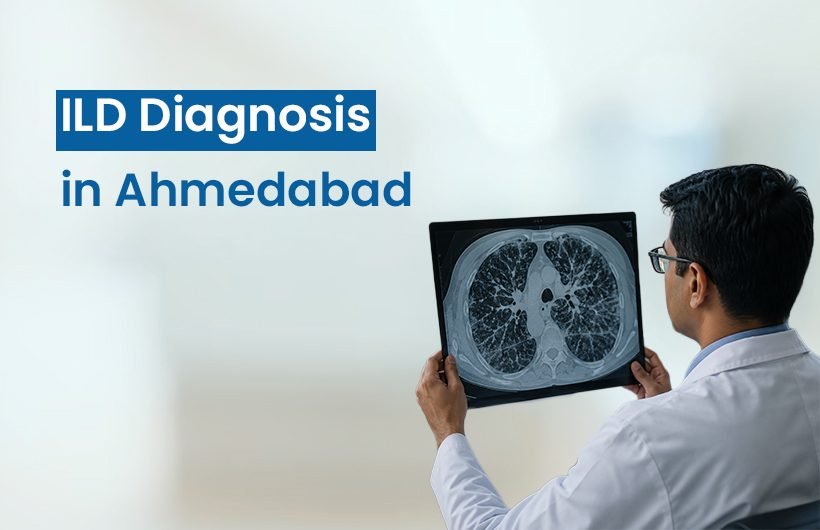
High-Resolution CT (HRCT) of the chest is the cornerstone of ILD diagnosis in Ahmedabad and globally. Unlike a standard chest X-ray, HRCT produces detailed cross-sectional images of the lung tissue and can reveal characteristic patterns such as ground-glass opacities, honeycombing, or reticular changes, which point toward specific types of ILD.
Dr. Rushi Desai reviews HRCT images in detail and uses the findings to guide the next steps in your diagnostic workup without unnecessary delay.
2) Pulmonary Function Test (PFT)
A Pulmonary Function Test (PFT) measures how well your lungs are actually working. In ILD, the lungs typically show a restrictive pattern, meaning they hold less air than normal and struggle to transfer oxygen into the bloodstream.
The key measurements include:
- Forced Vital Capacity (FVC): the total volume of air you can exhale
- Total Lung Capacity (TLC): how much air your lungs can hold
- DLCO (Diffusion Capacity): how efficiently oxygen crosses from the air sacs into the blood
PFT results help your doctor understand the severity of disease and track whether it is progressing or responding to treatment over time.
3) Bronchoscopy with Bronchoalveolar Lavage (BAL)
Bronchoscopy is a procedure in which a thin, flexible tube is passed through the nose or mouth into the airways of the lungs. Dr. Rushi Desai performs both diagnostic and therapeutic bronchoscopy as part of the ILD evaluation process.
During the procedure, the doctor can wash out the air sacs with a small amount of saline in a technique called Bronchoalveolar Lavage (BAL). The fluid collected is then analysed to identify the types of cells present, which can differentiate between various forms of ILD and rule out infection or malignancy.
This test is typically done under sedation, so you are comfortable and the procedure takes less than an hour.
4) Cryo-Lung Biopsy: Advanced Tissue Sampling
When HRCT and BAL do not provide a definitive diagnosis, a tissue sample (biopsy) from the lung is needed. Dr. Rushi Desai performs Cryo-Lung Biopsy, a bronchoscopic technique where a small cryoprobe freezes and retrieves a larger, better-quality tissue sample than conventional forceps biopsy.
This is a significant advantage. A larger sample means the pathologist has more material to work with, improving diagnostic accuracy. Your pulmonologist will advise whether this step is appropriate for your situation.
5) Thoracoscopy
In cases where a larger biopsy is required, or when there is significant pleural involvement, a Thoracoscopy may be recommended. This is a minimally invasive procedure in which a small camera is inserted into the chest cavity through a tiny incision to directly visualise the lung surface and collect tissue samples.
Dr. Rushi Desai performs Medical Thoracoscopy as part of the advanced ILD diagnostic process. The most appropriate approach always depends on your specific clinical picture, the extent of disease, and available expertise. Always discuss this in detail with your specialist before proceeding.
6) Blood Tests and Autoimmune Panel
ILD is frequently linked to autoimmune conditions. A targeted blood panel is an essential part of the diagnostic workup and includes:
- Antinuclear Antibody (ANA) and anti-dsDNA: for lupus-related ILD
- Anti-CCP and Rheumatoid Factor: for rheumatoid-associated ILD
- Myositis antibody panel (anti-Jo-1, MDA5, etc.): for inflammatory myositis with ILD
- Complement levels and inflammatory markers (ESR, CRP)
These results allow your pulmonologist to work closely with a rheumatologist when autoimmune disease is the underlying cause, which is more common than many patients realise.
How Does the Diagnosis Come Together?
No single test diagnoses ILD on its own. Dr. Rushi Desai reviews all diagnostic findings together including HRCT patterns, PFT results, BAL cell analysis, biopsy histology, and blood work, often in coordination with radiologists and pathologists, to arrive at the most accurate diagnosis possible.
This combined approach is the international gold standard for ILD diagnosis, and it is what separates a precise diagnosis from an educated guess. The goal is always to arrive at the most accurate diagnosis possible before any treatment decision is made.
About Dr. Rushi Desai
Dr. Rushi Desai is an experienced Interstitial Lung Disease specialist is a specialist pulmonologist in Ahmedabad with expertise in ILD, pulmonary fibrosis, pulmonary hypertension, and complex respiratory conditions. He performs the full spectrum of ILD diagnostic procedures, including HRCT evaluation, PFT, Bronchoscopy with BAL, Cryo-Lung Biopsy, Thoracoscopy, and autoimmune blood panels, ensuring every patient receives a precise and personalised diagnosis.
What Happens After the Diagnosis?
A confirmed ILD diagnosis opens the door to targeted treatment. Depending on the type and severity, management may include anti-fibrotic medications, immunosuppressants, pulmonary rehabilitation, or evaluation for lung transplant in advanced cases.
Some patients also develop Pulmonary Hypertension as a complication of ILD, which requires additional monitoring and treatment. Your specialist will screen for this as part of a comprehensive follow-up plan.
The most important thing to know is that a precise diagnosis always leads to better treatment decisions. Wherever you are in this journey, discuss your test results, your options, and your next steps with your specialist before deciding on any course of action. To book a consultation for ILD diagnosis in Ahmedabad.
FAQs
What is ILD and how is it different from other lung diseases?
ILD is a group of over 200 conditions that cause progressive scarring of the lung tissue. Unlike asthma or COPD, which primarily affect the airways, ILD affects the lung tissue itself, making it stiff and reducing the lungs’ ability to transfer oxygen into the blood. Early and accurate diagnosis is essential because some forms of ILD are irreversible if left untreated.
How do I know if I need an ILD test?
You should see a specialist if you have persistent breathlessness that is getting worse over time, a dry cough that does not respond to standard treatment, or if you have an autoimmune condition such as rheumatoid arthritis or lupus with any new lung symptoms. An abnormal chest X-ray or CT scan is also a common reason for referral.
What is the most important test for diagnosing ILD?
HRCT (High-Resolution CT) of the chest is typically the first and most important imaging test. It can reveal characteristic patterns in the lung tissue that point toward specific types of ILD. However, a complete diagnosis usually requires combining HRCT results with Pulmonary Function Tests, blood work, and in some cases a biopsy.
Is bronchoscopy painful?
No. Bronchoscopy is performed under sedation, so you are comfortable throughout the procedure and will not feel the tube. Most patients do not remember the procedure at all. It typically takes less than an hour and you are monitored before being discharged.
Does Dr. Rushi Desai perform lung biopsies for ILD?
Yes. Dr. Rushi Desai performs Cryo-Lung Biopsy, an advanced bronchoscopic technique that retrieves a larger, better-quality tissue sample compared to conventional biopsy methods. This improves diagnostic accuracy significantly. In cases where a larger sample is needed, Thoracoscopy may also be performed.
Can ILD be caused by an autoimmune disease?
Yes, and it is more common than many patients realise. Conditions like rheumatoid arthritis, lupus, myositis, and scleroderma can all cause ILD as a complication. Dr. Rushi Desai includes a detailed autoimmune blood panel as part of the ILD diagnostic workup to identify or rule out this connection.
How long does the ILD diagnostic process take?
The timeline depends on which tests are needed. Basic tests like HRCT and PFT can be completed within a few days. If a bronchoscopy or biopsy is required, the full diagnostic process may take one to two weeks, including time for laboratory analysis of samples. Dr. Rushi Desai will give you a clear picture of the expected timeline at your initial consultation.