
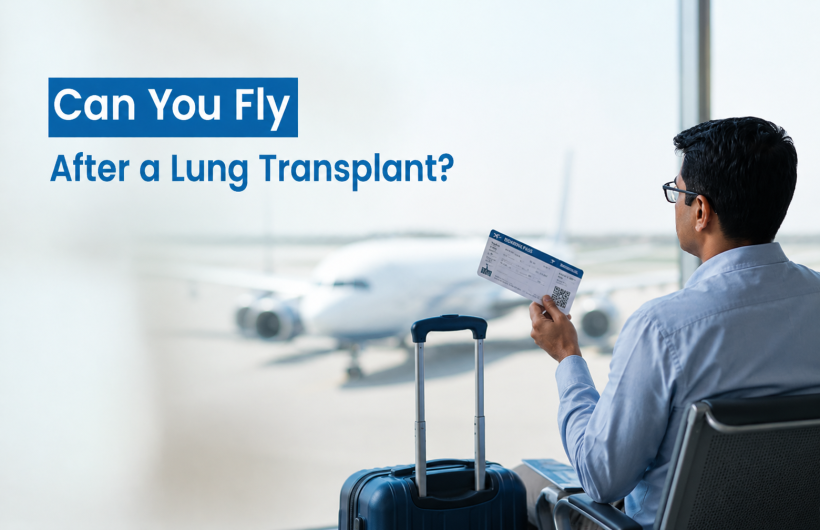
Yes, you can fly after a lung transplant.
But not immediately after surgery, and not without preparation. Flying after lung transplant surgery requires careful timing, your transplant team’s clearance, and a few non-negotiable precautions.
This article answers the most common questions patients ask about air travel after a lung transplant, including when it is safe, what risks to watch for, and how to travel smart.
When Can You Fly After a Lung Transplant?
There is no single date that works for everyone. Your recovery is unique to you.
That said, most transplant teams in India and around the world generally advise waiting at least 3 to 6 months before any air travel. For international flights, the wait is usually longer, often 6 to 12 months after surgery.
Why so long? Because the first few months after a lung transplant are the most critical. Your new lungs are still settling in. Your immune system is being suppressed with medications to prevent rejection. Your body needs close monitoring.
What Happens in Those First Few Months?
In the early weeks, your doctors will schedule you for frequent check-ups, bronchoscopies (where a camera is passed into your lungs to check their condition), blood tests, and lung function tests. These appointments are not optional. They are what keep you safe.
If you travel far from your transplant centre during this time, getting help quickly becomes much harder. This is why your team will ask you to stay nearby.
Once your lung function is stable and your medications are well-balanced, your doctor may clear you for short flights first, and then longer ones over time.
Is Flying Safe for Lung Transplant Patients?
For most patients who are well past the initial recovery phase, flying is safe with the right precautions. Cabin air pressure on commercial flights is equivalent to being at an altitude of roughly 6,000 to 8,000 feet above sea level. This means slightly less oxygen in the air than you breathe on the ground.
For someone with healthy lungs, this is barely noticeable. For a transplant recipient, especially one still building lung function, it is something to discuss with your doctor before flying.
Research shows that with careful preparation, oxygen monitoring, and adequate planning, most patients with lung conditions can travel by air safely.
Key Risks to Be Aware Of
- Infection risk: Aeroplanes are enclosed spaces with recirculated air. As a lung transplant recipient on immunosuppressive medications, your infection risk is higher than the average traveller.
- Reduced cabin oxygen: Lower oxygen levels at altitude can strain your respiratory system if your lung function is still recovering.
- Blood clot risk: Long flights increase the risk of blood clots. This risk can be higher after major surgery.
- Medication timing: Your immunosuppressants have to be taken at very specific times. Crossing time zones can throw this off if you do not plan ahead.
- Distance from your transplant centre: If a rejection episode or complication occurs mid-trip, you may be far from the team that knows your case best.
Practical Precautions Before You Fly
Flying after a lung transplant is possible, but it takes planning. Here is what you need to do before you get on a plane.
1. Get Clearance from Your Transplant Team
This is the most important step. Do not book your flight before speaking to your pulmonologist or transplant coordinator. They will review your current lung function, recent blood tests, and immunosuppression levels to decide whether you are ready.
If you are looking for expert guidance on lung transplant follow-up care, Dr. Rushi Desai, a Pulmonologist in Ahmedabad specialising in lung transplant, pulmonary hypertension, and interstitial lung disease, can help you make an informed decision about travel readiness.
2. Carry All Medications in Your Hand Luggage
Never put your immunosuppressive medications in checked baggage. Luggage can be delayed, lost, or exposed to extreme temperatures in the cargo hold. Your medications must stay with you in the cabin at all times.
Carry enough supply for extra days beyond your trip length, in case of flight delays or cancellations. Bring a written list of all medications, doses, and the contact details of your transplant team.
3. Time Zone and Dosing
If you are crossing time zones, speak to your transplant pharmacist before you travel. Immunosuppressants like tacrolimus have narrow dosing windows. Missing a dose or taking it at the wrong time can affect drug levels and increase the risk of rejection.
Your team will advise you on how to adjust your schedule based on the number of hours you are crossing.
4. Know the Nearest Transplant Centre at Your Destination
Before you travel, research which hospital at your destination has a lung transplant unit or a strong respiratory care team. Store their address and emergency contact number on your phone.
If you are travelling internationally, your transplant team may advise you on the quality of local healthcare and whether the destination is appropriate given your current health status.
5. Get Travel Insurance That Covers Your Condition
Standard travel insurance often excludes pre-existing medical conditions. Make sure your policy explicitly covers post-transplant complications, potential hospitalisation abroad, and medical evacuation if needed.
6. Wear a Mask on the Plane
Aeroplanes concentrate a large number of people in a small space. For immunosuppressed patients, wearing a well-fitting surgical or N95 mask during the flight significantly reduces the risk of picking up a respiratory infection.
7. Move Around and Stay Hydrated
On longer flights, walk the aisle when it is safe to do so and do simple leg exercises in your seat. This reduces your risk of deep vein thrombosis. Drink water regularly and avoid alcohol, which dehydrates you and can interfere with your medications.
Special Considerations for International Travel
International travel after a lung transplant adds another layer of complexity beyond just getting on a plane.
- Vaccines: Many live vaccines, including yellow fever, MMR, and others, are not safe for transplant recipients on immunosuppression. If your destination requires certain vaccinations, check with your transplant team well in advance. Some destinations may not be advisable at all.
- Food safety: Stick to fully cooked food. Avoid raw meats, raw seafood, and unpeeled fruits and vegetables. Food-borne illness that most people shake off in a day can become serious for you.
- Sun protection: Immunosuppressive medications increase your skin cancer risk significantly. Use SPF 50 or higher sunscreen, cover up, and limit time in direct sun, especially in tropical countries.
- High-altitude cities: Places like Leh, Shimla, or high-altitude cities abroad have lower oxygen levels. If your lung function is not yet strong, these destinations may not be right for you. Discuss it with your doctor.
What to Do If You Feel Unwell During Your Trip
Even with all the preparation in the world, your body can sometimes react unexpectedly. If any of these happen while you are travelling, get medical help straight away and contact your transplant team:
- Fever above 38 degrees Celsius
- Breathing that feels harder than normal for you
- Unusual tiredness or confusion
- One leg that is swollen, red, or painful (this could be a blood clot)
- A new cough, wheezing, or chest discomfort
Do not wait to see if it passes. Call your transplant centre immediately.
Conclusion
Flying after a lung transplant is not just a dream. For many patients, it becomes a reality within the first year of recovery. People have taken domestic trips, visited family, and even explored other countries after transplant.
But the key is always the same: do not make this decision alone.
Your transplant team knows your lungs, your medications, and your recovery better than anyone. Their clearance is what turns a risky trip into a safe one.
If you are a lung transplant patient in India and want expert guidance on travel readiness or post-transplant care, Dr. Rushi Desai is a trusted Pulmonologist in Ahmedabad who specialises in lung transplant, pulmonary hypertension, and interstitial lung disease. Discuss your travel plans with your specialist before you book anything.
FAQs
How long after a lung transplant can I fly?
Most patients wait 3 to 6 months before a domestic flight and 6 to 12 months before international travel. Your specific timeline is something only your transplant team can confirm based on your recovery.
Will I need oxygen on the plane?
Most stable, well-recovered lung transplant patients do not need supplemental oxygen on a flight. However, if your oxygen levels are borderline, your doctor may recommend it. You cannot bring your own oxygen cylinder on a commercial flight. It has to be arranged in advance with the airline, which usually requires a medical certificate.
Can I travel on my own or do I need someone with me?
In the early months after your transplant, travelling with a companion is strongly recommended. Someone who knows your medications, your medical history, and what to do in an emergency is a huge safety net.
What documents should I carry?
Always travel with a full medication list (with generic drug names and doses), a letter from your transplant team summarising your condition, the emergency contact number for your transplant centre, and your travel insurance documents.