
If you or a family member has recently heard the term “pulmonary hypertension,” one of the first things worth understanding is that it isn’t a single disease. It’s an umbrella term for high blood pressure in the lung arteries that can develop for several different reasons. Doctors classify it into five distinct groups, and knowing which group applies to a person matters because it shapes how the condition is investigated and managed.
At Dr. Rushi Desai’s pulmonology practice in Ahmedabad, patients often arrive with a report that mentions “pulmonary hypertension” without much explanation of what type they have. This article walks through what pulmonary hypertension is, the five recognised groups, how each one differs, and what the diagnostic and treatment process generally looks like.
This article is for general education and isn’t a substitute for a medical consultation. If any of this sounds like your situation, please talk to a qualified pulmonologist or cardiologist.
What Are the Five Groups of Pulmonary Hypertension?
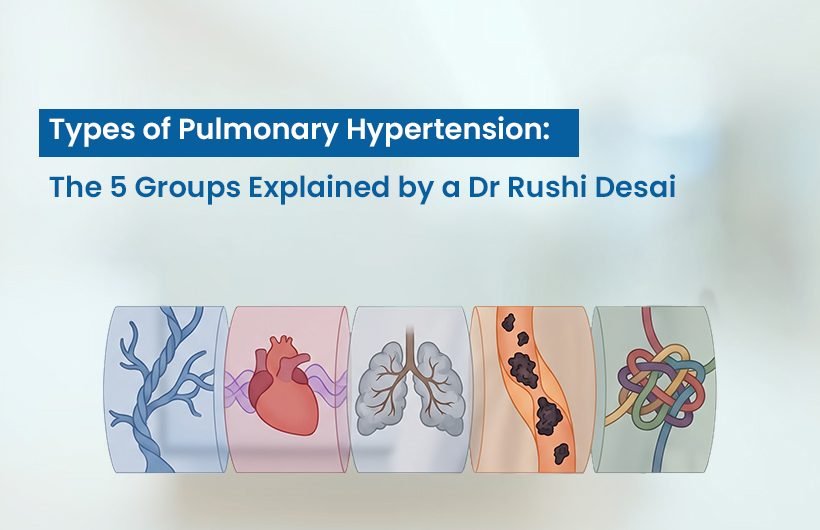
The World Health Organization (WHO) classifies pulmonary hypertension into five groups based on the underlying mechanism and cause:
- Group 1 – Pulmonary Arterial Hypertension (PAH)
- Group 2 – Pulmonary Hypertension Due to Left Heart Disease
- Group 3 – Pulmonary Hypertension Due to Lung Disease and/or Hypoxia
- Group 4 – Chronic Thromboembolic Pulmonary Hypertension (CTEPH)
- Group 5 – Pulmonary Hypertension With Unclear or Multifactorial Mechanisms
Each group has a different primary cause, which is why identifying the correct group is central to planning appropriate care. Below is a closer look at each one.
Group 1 – Pulmonary Arterial Hypertension (PAH)
Group 1 PAH is a disease of the small pulmonary arteries themselves. The walls of these vessels thicken and narrow, which raises resistance to blood flow and increases pressure in the lung circulation.
PAH can be idiopathic (no identifiable cause), hereditary, or associated with other conditions such as connective tissue diseases (like scleroderma or lupus), congenital heart disease, HIV infection, portal hypertension, or certain drug and toxin exposures. PAH is considered a rare but serious condition and typically needs ongoing specialist management.
Group 2 – Pulmonary Hypertension Due to Left Heart Disease
This is one of the most common causes of pulmonary hypertension overall. When the left side of the heart doesn’t pump or relax efficiently due to conditions like heart failure, valve disease, or long-standing high blood pressure affecting the heart, pressure backs up into the pulmonary circulation.
Here, the lungs themselves are usually not the primary problem; the pressure rise is a downstream effect of the heart’s reduced efficiency. Managing the underlying heart condition is central to addressing Group 2 PH.
Group 3 – Pulmonary Hypertension Due to Lung Disease and/or Hypoxia
Chronic lung conditions such as COPD, interstitial lung disease (ILD), and long-term low blood oxygen levels (hypoxia), including from severe sleep apnea, can cause the blood vessels in the lungs to narrow over time as a response to reduced oxygen. This raises pulmonary artery pressure.
In these cases, the lung disease usually comes first, and the pulmonary hypertension develops as a consequence. Managing the underlying lung condition and correcting oxygen levels where appropriate are important parts of care.
Group 4 – Pulmonary Hypertension Due to Chronic Blood Clots (CTEPH)
Chronic thromboembolic pulmonary hypertension (CTEPH) develops when blood clots in the lung arteries don’t fully dissolve after a pulmonary embolism. Instead, they organize into scar-like tissue that permanently obstructs blood flow, raising pressure in the pulmonary circulation.
CTEPH is notable because, unlike most other groups, it is potentially treatable with a specialised surgical procedure in eligible patients, in addition to medical therapy. This makes accurate identification of Group 4 particularly important.
Group 5 – Pulmonary Hypertension With Unclear or Multifactorial Mechanisms
Group 5 is a catch-all category for pulmonary hypertension linked to conditions where the mechanism is complex, not fully understood, or involves multiple contributing factors. Examples include certain blood disorders, metabolic conditions, and other systemic diseases that don’t fit clearly into Groups 1 through 4.
Because the underlying drivers vary so much within this group, management is guided largely by the associated condition.
Symptoms of Pulmonary Hypertension
Symptoms tend to overlap across the five groups and often overlap with other heart and lung conditions too, which is part of why pulmonary hypertension can take time to diagnose. Common symptoms include:
- Shortness of breath, especially during physical activity
- Unusual fatigue or low energy
- Chest discomfort or tightness
- Dizziness or lightheadedness
- Fainting or near-fainting episodes
- Reduced ability to exercise compared to before
- Swelling in the legs or ankles in more advanced cases
Because these symptoms are shared with many other conditions, they aren’t specific to pulmonary hypertension on their own. If breathlessness or fatigue is persistent and unexplained, it’s worth having it evaluated rather than assuming it will resolve on its own.
How Is Pulmonary Hypertension Diagnosed?
There’s no single test that diagnoses pulmonary hypertension in isolation. Instead, doctors use a combination of tools to identify PH, estimate its severity, and importantly work out which of the five groups is responsible:
- Medical history and physical examination, to look for clues pointing toward heart disease, lung disease, or clotting disorders
- Electrocardiogram (ECG), which can show signs suggestive of strain on the right side of the heart, but cannot confirm or rule out pulmonary hypertension by itself
- Echocardiogram, which estimates pulmonary artery pressure and assesses how the heart is functioning usually the first major screening test
- Chest imaging (X-ray or CT scan), to look for underlying lung disease
- Pulmonary function tests, to assess lung capacity and airflow
- Blood tests, which may include autoimmune markers, thyroid function, or other relevant panels depending on the suspected cause
- Right heart catheterisation, considered the gold-standard confirmatory test, which directly measures the pressure inside the pulmonary arteries and is typically used when the diagnosis needs to be confirmed or when planning targeted treatment
- V/Q scan, particularly useful for identifying chronic blood clots associated with CTEPH (Group 4)
Diagnosis is usually a step-by-step process rather than a single visit, since confirming both the presence of PH and its underlying group guides the treatment plan that follows.
Treatment of Pulmonary Hypertension
There’s an important point worth repeating here: treatment for pulmonary hypertension depends heavily on which group is involved and what’s driving it. There is no single treatment that applies to all five groups equally.
Broadly, treatment approaches may include:
- Managing the underlying condition for example, optimising heart failure treatment in Group 2, or treating the lung disease in Group 3
- Group-specific medications for Group 1 PAH, which may include drugs that help relax and widen the pulmonary arteries
- Anticoagulation (blood thinners) in selected patients, particularly relevant in CTEPH
- Surgical or procedural options, such as pulmonary endarterectomy for eligible CTEPH patients
- Oxygen therapy, when blood oxygen levels are low
- Supportive care, including activity guidance, diet, and pulmonary rehabilitation where appropriate
- Ongoing specialist follow-up, since pulmonary hypertension is typically a long-term condition that needs monitoring over time
None of this is meant as individual medical advice; the right combination of treatments depends on a detailed evaluation by a specialist familiar with your specific group and overall health.
What Should You Avoid With Pulmonary Hypertension?
While individual guidance should come from your treating doctor, some general precautions are commonly advised for people living with pulmonary hypertension:
- Avoid strenuous or high-intensity physical exertion without medical guidance; supervised, moderate activity is often more appropriate. See our related article on exercise and pulmonary hypertension for more detail
- Avoid high altitudes or environments with low oxygen availability without medical clearance
- Avoid smoking and exposure to secondhand smoke, which can worsen both heart and lung strain
- Avoid excess salt and fluid intake if you also have signs of heart strain or fluid retention, as advised by your doctor
- Avoid starting or stopping any medication, including over-the-counter drugs or supplements, without checking with your treating physician, since some can interact with PH-specific therapies
- Avoid skipping follow-up appointments, since PH is a condition that needs periodic reassessment over time
These are general precautions, not a personalised treatment plan. What’s appropriate for one person may not apply to another, depending on their specific group and overall health.
When Should You See a Pulmonologist?
If you’re experiencing unexplained breathlessness, persistent fatigue, or fainting spells, particularly if these are new or worsening, it’s reasonable to have them evaluated rather than waiting for symptoms to resolve on their own. This is especially true if you already have a heart condition, chronic lung disease, or a history of blood clots, since these raise the likelihood of pulmonary hypertension developing.
Dr Rushi Desai is a pulmonologist in Ahmedabad with a focus on complex respiratory and pulmonary vascular conditions, including pulmonary hypertension. Patients looking for a pulmonary hypertension specialist in Ahmedabad can expect a structured evaluation aimed at identifying both the presence of PH and the specific group involved, which is the foundation for appropriate management.
Concerned about a pulmonary hypertension
Dr. Rushi Desai offers evaluation and management for pulmonary hypertension and related respiratory conditions in Ahmedabad.
Frequently Asked Questions
What are the five types of pulmonary hypertension?
The five types are Group 1 (Pulmonary Arterial Hypertension), Group 2 (due to left heart disease), Group 3 (due to lung disease and/or low oxygen levels), Group 4 (chronic thromboembolic pulmonary hypertension, caused by chronic blood clots), and Group 5 (unclear or multifactorial mechanisms). Each group has a different underlying cause, which is why classification is an important step before deciding on treatment. A pulmonologist typically uses a combination of tests to determine which group applies to a specific patient.
What is the first-line treatment for pulmonary hypertension?
There isn’t one universal first-line treatment, because it depends on which of the five groups is involved. For Group 2 and Group 3 PH, treatment usually starts by managing the underlying heart or lung condition. For Group 1 PAH, specific PAH-targeted medications are typically used. For Group 4 (CTEPH), evaluation for a surgical option is often an early step in eligible patients. A specialist will recommend an approach based on your specific diagnosis and test results.
Can pulmonary hypertension be detected on an ECG?
An ECG can show changes suggestive of strain on the right side of the heart, which may raise suspicion of pulmonary hypertension, but it cannot confirm the diagnosis on its own. Diagnosis typically relies on an echocardiogram as an initial screening test, followed by right heart catheterisation, which is considered the gold-standard confirmatory test. If your ECG shows findings that concern your doctor, further testing is usually the next step rather than a diagnosis based on the ECG alone.
What is the new treatment for pulmonary hypertension?
One notable recent development is sotatercept, an injectable therapy approved by the FDA in March 2024 specifically for adults with Group 1 Pulmonary Arterial Hypertension, used alongside existing PAH treatments. It reflects a different treatment approach compared to older PAH medications. It’s important to note that this therapy is specific to Group 1 PAH and is not a universal treatment for all five groups of pulmonary hypertension. Whether it or any other newer therapy is suitable depends on individual evaluation by a treating specialist.
What oxygen level is concerning in pulmonary hypertension?
There is no single oxygen saturation number that alone diagnoses or defines severity in pulmonary hypertension; oxygen levels need to be interpreted together with symptoms, the underlying cause, and other clinical findings. That said, persistently low or dropping oxygen saturation is generally something that should be discussed with a doctor rather than managed independently, particularly for people with known heart or lung conditions. In certain groups, such as Group 3, correcting low oxygen through supervised therapy is often part of the treatment plan.
What should you avoid with pulmonary hypertension?
In general, people with pulmonary hypertension are often advised to avoid unsupervised strenuous exertion, high-altitude exposure without medical clearance, smoking, and starting or stopping medications without medical guidance. These are general precautions rather than a personalised plan; what’s appropriate depends on your specific group, symptoms, and overall health, so it’s best discussed directly with your treating pulmonologist or cardiologist.