
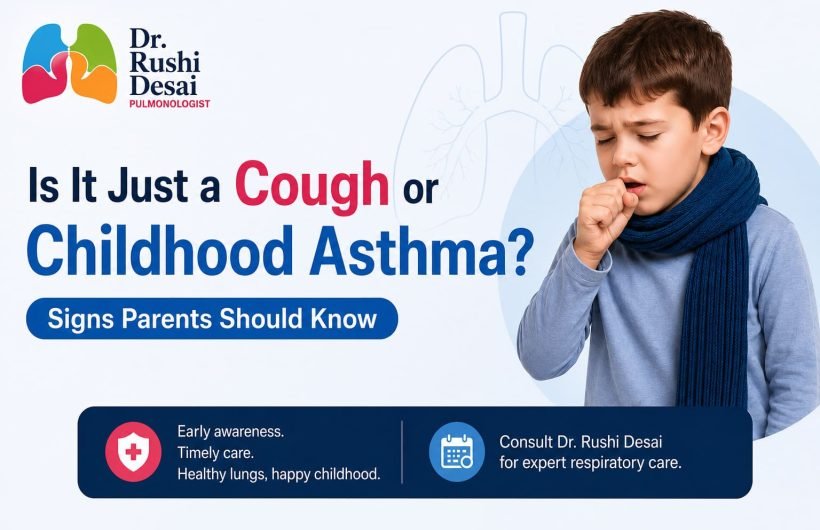
A cough that won’t go away is one of the most common reasons parents bring their child to a doctor — and one of the hardest symptoms to read correctly. Most coughs are harmless and clear up on their own. But sometimes, a persistent cough is the first visible sign of childhood asthma, a chronic lung condition that affects how a child’s airways react to triggers in everyday life.
As a practising pulmonologist and lung specialist, Dr Rushi Desai sees this exact question from worried parents almost every week: “Is this just a cough, or could it be asthma?” This guide breaks down the real differences, so you know when to relax and when to get your child checked.
What Is Childhood Asthma?
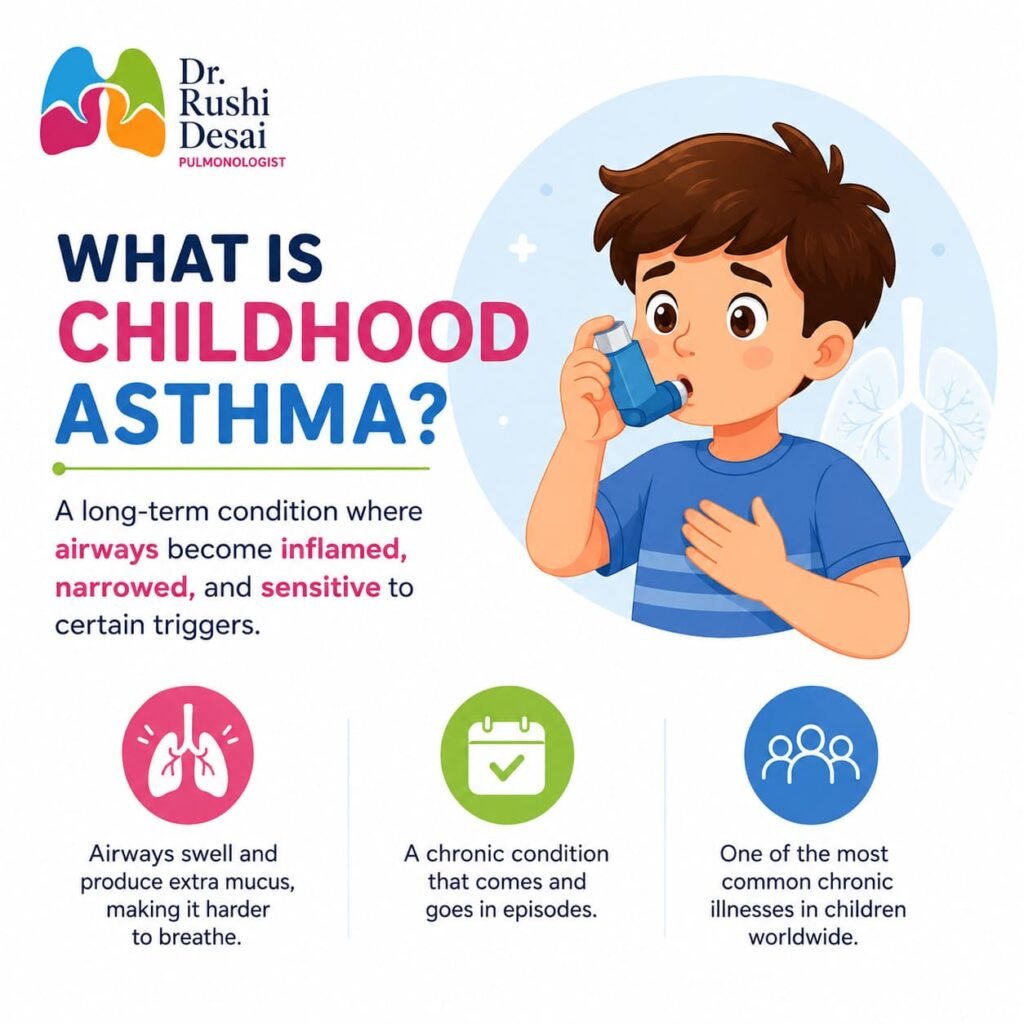
Childhood asthma is a long-term condition in which the airways inside a child’s lungs become inflamed, narrowed, and overly sensitive to certain triggers. When exposed to things like dust, smoke, cold air, or a viral infection, these sensitive airways swell and produce extra mucus, making it harder for air to move in and out.
Unlike a regular cough caused by a cold, asthma is a chronic respiratory condition — meaning it doesn’t fully disappear after a week or two. It tends to come and go in episodes, often called asthma flare-ups or attacks, and usually needs ongoing management rather than a single round of treatment.
Childhood asthma is one of the most common chronic illnesses in children worldwide, and it often starts before the age of five, though it can be diagnosed at any age.
Cough vs Childhood Asthma: How to Tell the Difference
The difference between a cough and childhood asthma usually comes down to pattern, timing, and accompanying symptoms — not just the sound of the cough itself.
🤧 Ordinary Cough vs 🫁 Childhood Asthma
⏳ Duration
Usually resolves within 7–10 days.
May last for weeks or keep recurring.
🌙 Timing
Worse during illness, then gradually improves.
Often worse at night or early morning.
🌿 Triggers
Usually follows a cold or viral infection.
Triggered by exercise, allergens, weather changes, laughing, or crying.
🔊 Associated Sounds
Usually just coughing.
Wheezing or a whistling sound while breathing.
😮💨 Breathing
Breathing returns to normal once the cold passes.
Shortness of breath, rapid breathing, and chest tightness.
🔄 Pattern
Usually a one-off episode.
Symptoms tend to recur over months.
Symptoms of Childhood Asthma Parents Should Watch For
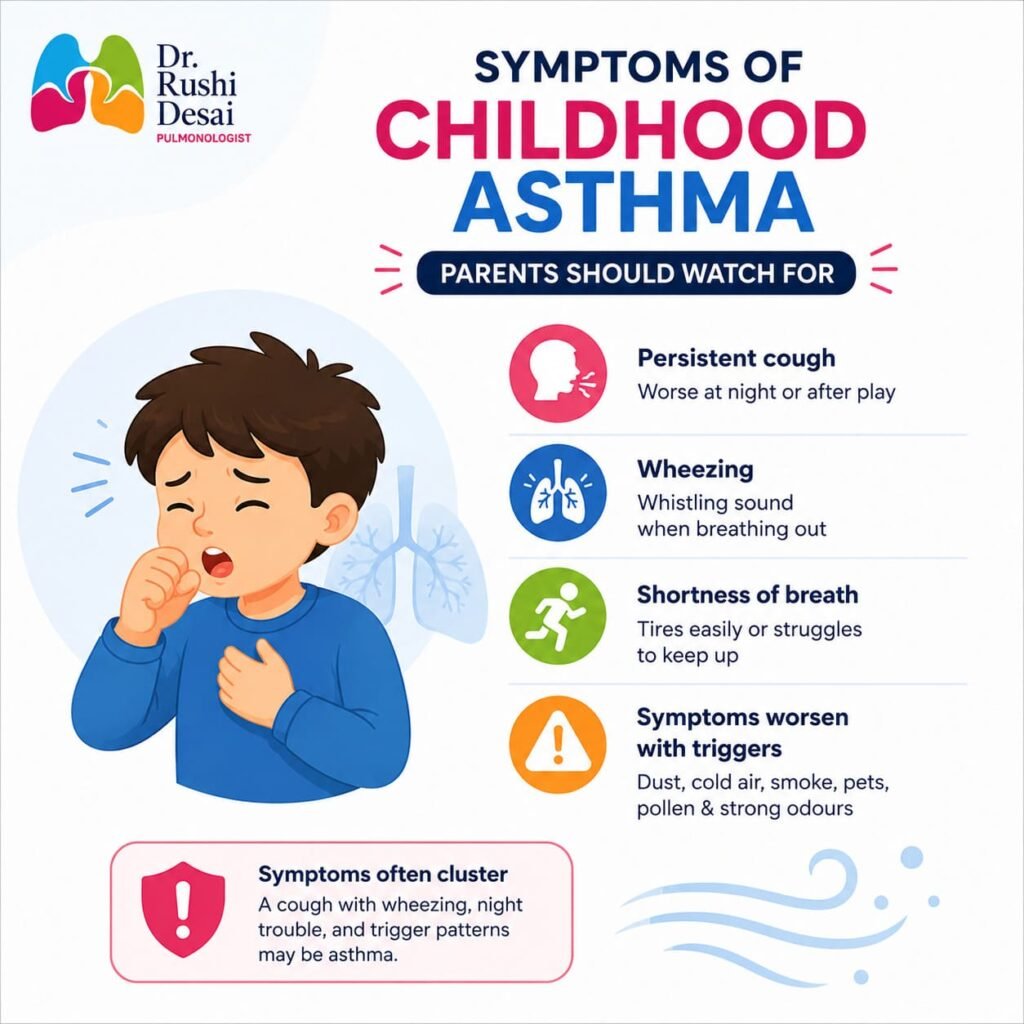
The symptoms of childhood asthma can be subtle at first, especially in toddlers and young children who can’t clearly describe how they feel. Look for these patterns:
- Persistent or recurring cough — especially one that worsens at night, disrupts sleep, or appears after playing or running
- Wheezing — a high-pitched whistling sound when your child breathes out
- Shortness of breath — your child seems to tire quickly during play or struggles to keep up with peers
- Chest tightness or pain — older children may describe their chest as feeling “tight” or “squeezed”
- Rapid or laboured breathing — visible effort to breathe, flaring nostrils, or the skin around the ribs pulling in with each breath
- Fatigue during physical activity — avoiding sports or getting unusually breathless compared to other kids
- Symptoms that worsen with specific triggers — cold air, dust, pet dander, pollen, smoke, or strong odours
A key warning sign is the clustering of symptoms. A child with asthma rarely has just a cough — it’s usually the cough plus wheezing, plus nighttime disruption, plus a pattern tied to triggers.
What Causes Childhood Asthma?
There isn’t one single cause of asthma. Instead, it develops from a combination of genetic and environmental factors. Common causes of childhood asthma include:
- Family history — children with a parent or sibling who has asthma or allergies have a higher risk
- Allergies — kids with eczema, hay fever, or food allergies are more prone to developing asthma
- Respiratory infections in early childhood — repeated viral infections (like RSV) in infancy can affect airway development
- Exposure to tobacco smoke — both during pregnancy and after birth, secondhand smoke significantly raises asthma risk
- Environmental pollutants — air pollution, dust mites, mold, and pest allergens can trigger or worsen symptoms
- Premature birth or low birth weight — these can affect lung development
- Obesity — excess weight is linked to a higher likelihood of asthma symptoms in children
When Should a Cough Worry You?
Not every cough needs a specialist visit, but certain patterns are red flags that point toward something more than a common cold.
Cough That Lasts More Than 2–3 Weeks
A cold-related cough should improve steadily and clear within 7–10 days. If it lingers for three weeks or longer — or improves and then returns — it’s worth investigating further.
Cough Without a Cold
If your child develops a cough with no fever, runny nose, or other cold symptoms — particularly if it appears after running, laughing, or exposure to cold air — this is a classic asthma pattern, not a typical viral cough.
Nighttime Cough That Disrupts Sleep
Airways naturally narrow slightly at night, which is why asthma symptoms often peak between midnight and early morning. A child who coughs persistently after falling asleep or wakes up coughing should be evaluated.
Cough With Wheezing or Breathlessness
Any cough accompanied by wheezing, breathlessness, a whistling sound, visible breathing effort, or your child struggling to speak full sentences during an episode needs prompt medical attention.
How Is Childhood Asthma Diagnosed?
Diagnosing asthma in children involves more than listening to a cough. A Dr Rushi Desai – Best Pulmonologist typically combines:
- Detailed symptom history — frequency, triggers, timing, and family history of asthma or allergies
- Physical examination — listening to lung sounds with a stethoscope during normal breathing and after activity
- Lung function tests — such as spirometry, used in children old enough to follow breathing instructions (usually age 5 and above)
- Trial of asthma medication — in younger children, where lung function tests aren’t practical, doctors may observe how symptoms respond to treatment
- Allergy testing, when allergic triggers are suspected
Because asthma symptoms can overlap with other respiratory conditions, an accurate diagnosis from an experienced pulmonologist matters — both to confirm asthma and to rule out other causes of chronic cough.
Asthma Treatment Options for Children
The good news: asthma treatment today allows the vast majority of children to live full, active lives — including playing sports — with the right management plan. Treatment is generally built around two goals:
- Long-term control — daily preventive medications (often inhaled corticosteroids) that reduce airway inflammation and prevent flare-ups before they start
- Quick relief — fast-acting inhalers (bronchodilators) used during an asthma episode to relax tightened airway muscles
When to See a Lung Specialist
You should consider a consultation with a pulmonologist or lung specialist if your child has:
- A cough lasting more than three weeks
- Recurrent wheezing episodes
- Nighttime coughing that affects sleep
- Breathlessness during normal play or exercise
- A family history of asthma or allergies combined with frequent respiratory symptoms
- Previous asthma diagnosis that isn’t responding well to current treatment
Listen to the Cough, Protect the Breath
Every cough tells a story — most are short ones that end with a cold’s last sneeze. But when the story repeats itself, night after night, season after season, it’s no longer “just a cough.” It’s your child’s airway trying to get your attention. Childhood asthma isn’t a lifelong sentence; it’s a condition that becomes far easier to live with once it’s correctly understood, tracked, and treated early.
Concerned About Your Child’s Persistent Cough?
If your child has a cough that keeps coming back, wheezing, or breathing difficulties, don’t ignore the symptoms. Early diagnosis by an experienced pulmonologist can help identify childhood asthma and provide the right treatment before it affects your child’s daily life.
✔ Early Diagnosis | ✔ Personalized Treatment | ✔ Expert Pulmonology Care
Frequently Asked Questions
How to know if it’s asthma or just a cough?
A cold cough fades within 7–10 days. Asthma-related cough lasts longer, often returns without a cold, gets worse at night or with exercise, and may come with wheezing or breathlessness — not just the cough alone.
How to help a child with asthma without an inhaler?
Between flare-ups, you can support your child by avoiding known triggers (dust, smoke, cold air, pet dander), keeping indoor air clean, encouraging slow nasal breathing during mild symptoms, and ensuring good sleep and hydration. These help reduce flare-ups, but they don’t replace prescribed inhalers — during an actual asthma attack, rescue medication is still essential.
What is a natural remedy for childhood asthma?
There’s no natural cure for asthma. Supportive steps like trigger avoidance, air purifiers, steam/humidity for congestion, and breathing exercises (like pursed-lip breathing) can ease mild symptoms, but they work alongside — not instead of — a doctor-prescribed treatment plan.
Can Vicks help with asthma?
No — Vicks VapoRub is meant for cold-related congestion, not asthma. Its strong menthol vapours can actually irritate sensitive airways and worsen breathing in young children, so it isn’t recommended as an asthma remedy.