
Your cough never fully settles, the stairs feel steeper every month, and your tablets no longer seem enough. Many families then ask if lung transplant for pulmonary fibrosis is the next step. As a pulmonologist in Ahmedabad, I will say this first: ask early, because the evaluation takes time.
- Ask about a transplant assessment at diagnosis, or as soon as the scarring keeps progressing.
- Listing becomes urgent when lung function, walking distance or oxygen needs keep worsening despite treatment.
- A transplant replaces damaged lungs. It is not a cure, and it needs lifelong medicines.
What Does Lung Transplant for Pulmonary Fibrosis Actually Do?
Pulmonary fibrosis means lung tissue becomes scarred and stiff. Scar tissue cannot be reversed with current medicines.
A transplant is the only treatment that replaces the damaged lungs. The two main treatment paths are:
- Medicines (antifibrotics): slow the scarring
- Surgery: swap the scarred lungs for donor lungs
Idiopathic pulmonary fibrosis (IPF) is the most common reason adults need a transplant for scarring. The same decision applies to other fibrosing diseases, such as hypersensitivity pneumonitis or connective-tissue-related disease.
IPF Lung Transplant vs ILD Lung Transplant: Is There a Difference?
The surgery is the same. The planning is not always the same.
- IPF: often progresses steadily. Median survival is roughly 3 to 5 years from diagnosis, so timing matters.
- Other ILDs: course varies. Autoimmune cases need checks for disease outside the lungs.
- Mixed picture: some patients also develop pulmonary hypertension, which can bring referral forward.
Both groups are assessed with the same core tests. Your diagnosis simply shapes the risk discussion.
Lung Transplant vs Antifibrotic Medicines: What Can Each Do?
Nintedanib and pirfenidone are the standard medicines. In the INPULSIS and ASCEND trials, they cut the yearly drop in lung capacity (FVC) by about half. They do not restore lost lung function.
| Antifibrotic medicines | Transplant | |
| Goal | Slow scarring | Replace damaged lungs |
| Effect on breathing | Rarely improves it | Can improve it substantially |
| Main risks | Nausea, diarrhoea, liver tests, rash | Rejection, infection, drug side effects |
| Who can have it | Most patients | Carefully selected patients only |
This is not an either-or choice. Most patients stay on medicines while a lung transplant specialist assesses them for surgery.
Registry data show a median survival of about 6 to 7 years after a transplant in adults. Results vary with age, diagnosis and complications.
When Should You Be Referred? Early Warning Markers
The 2021 International Society for Heart and Lung Transplantation (ISHLT) consensus advises referral early. You do not need to be critically ill.
Consider an assessment for lung transplant for pulmonary fibrosis if you have:
- A confirmed UIP pattern or fibrosing lung disease on CT
- FVC below 80% of predicted, or DLCO below 40%
- Breathlessness limiting daily activity
- Any need for oxygen
- A hospital stay for a sudden lung worsening or collapsed lung
These referral signs are not a promise of surgery. They simply start the safety checks and the conversation.
Signs It May Be Time for Listing
Listing is a later step. Disease progression is the main trigger.
Warning markers include:
- FVC falling by 10% or more in 6 months
- DLCO falling by 15% or more in 6 months
- Oxygen saturation dropping below 88% on a 6-minute walk
- Walking less than 250 metres, or losing over 50 metres in 6 months
- Signs of pulmonary hypertension
- An acute exacerbation needing admission
Any one of these should prompt an urgent review with your lung team.
Pulmonary Fibrosis Transplant Eligibility: Who Qualifies?
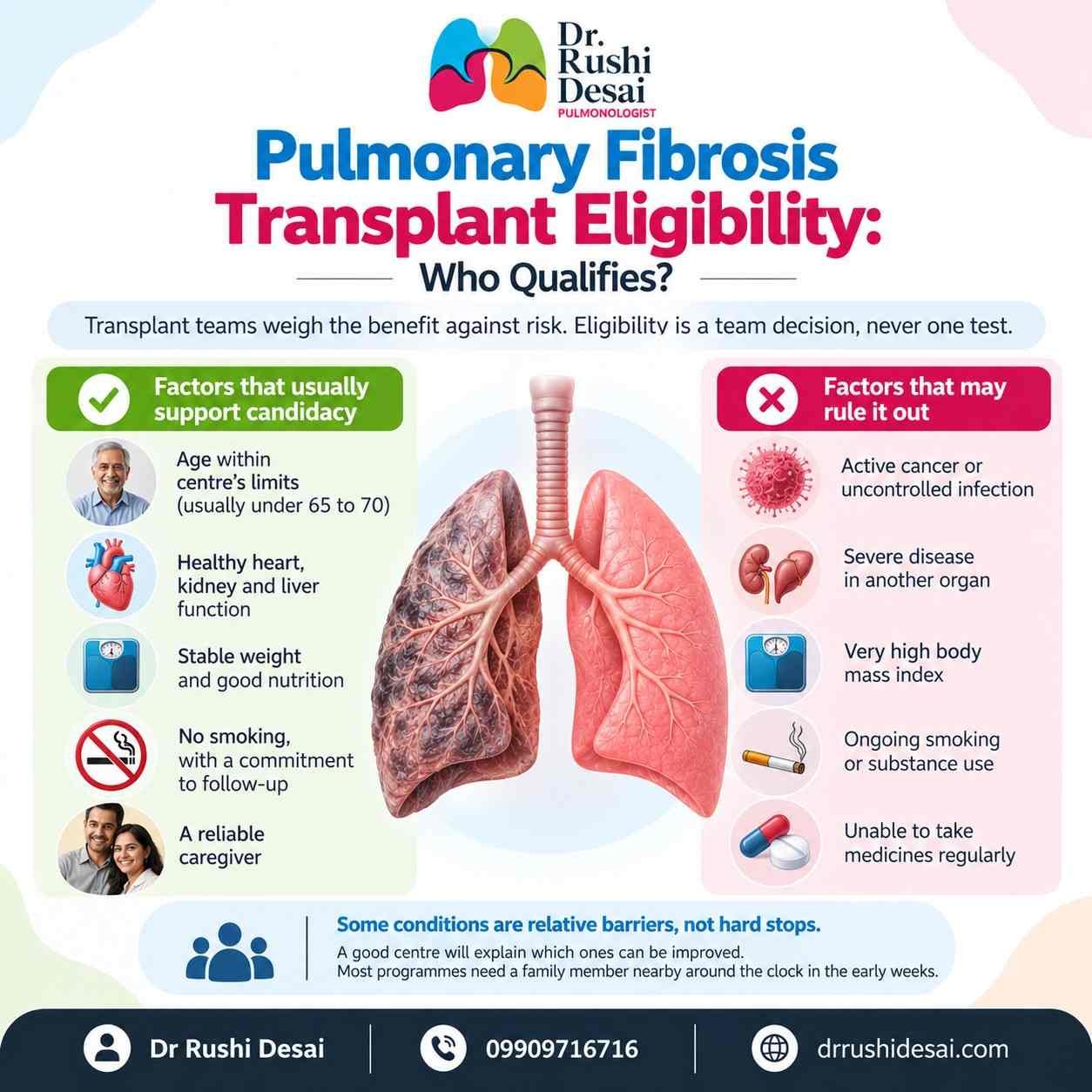
Transplant teams weigh the benefit against risk. Eligibility for lung transplant for pulmonary fibrosis is a team decision, never one test.
Factors that usually support candidacy:
- Age within the centre’s limits (often under 65 to 70)
- Healthy heart, kidney and liver function
- Stable weight and good nutrition
- No smoking, and a commitment to follow-up
- A reliable caregiver
Factors that may rule it out:
- Active cancer or uncontrolled infection
- Severe disease in another organ
- Very high body mass index
- Ongoing smoking or substance use
- Unable to take medicines regularly
Some conditions are relative barriers, not hard stops. A good centre will explain which ones can be improved. Ask about caregiver training too. Most programmes need a family member nearby around the clock in the early weeks.
Common Myths About Transplant in Pulmonary Fibrosis
Families often delay the conversation because of what they have heard. Here is what we tell patients.
- Myth: “Transplant is only for the last days.” Fact: Referral works best while you are still strong enough for surgery.
- Myth: “Referral means you must have surgery.” Fact: Assessment only maps your options.
- Myth: “Medicines make a transplant unnecessary.” Fact: Medicines slow the disease. They cannot rebuild scarred lungs.
What Happens During Evaluation and Surgery?
Evaluation usually involves these steps:
- HRCT chest scan and detailed lung function tests
- Heart tests, including a right-heart catheter study
- Blood tests, infection screening and tissue matching
- Dental, nutrition and mental-health review
- Meeting with your caregiver and family
In India, lungs come from brain-stem dead donors under the national organ donation framework. Waiting time is unpredictable.
Surgery can be a single or double lung transplant. It often takes several hours. Most patients then spend a few weeks in hospital and months in close follow-up, ideally near the transplant centre.
Recovery is gradual. Expect supervised rehabilitation, regular blood tests to adjust drug doses, and often bronchoscopy checks for early rejection. Most patients start walking within days, but full strength takes months.
What Are the Risks of Lung Transplant for Pulmonary Fibrosis?
An honest talk about risk is part of good care.
- Rejection: the body may attack the new lungs. Medicines lower the risk but do not remove it.
- Infection: immune-suppressing drugs make infections more likely.
- Long-term lung decline: chronic rejection can reduce function over the years.
- Drug effects: kidney strain, high blood pressure, diabetes and some cancers.
For many patients, breathing and daily activity improve a lot. Yet follow-up and discipline are lifelong.
How Can You Prepare While You Wait?
A fitter body handles surgery better. Use this time well.
- Join a pulmonary rehabilitation programme
- Keep up with vaccines for flu, pneumonia and COVID-19
- Use home oxygen therapy if saturation drops
- Avoid smoke, dust and heavy pollution days in Ahmedabad
- Eat well to keep your weight stable
- Plan finances and a caregiver early
Meet Your Doctor
Dr. Rushi Desai treats interstitial lung disease and guides patients through transplant evaluation at AB Plus Hospital in Ahmedabad. Each plan is built around your scan, lung tests and goals.
Conclusion
Lung transplant for pulmonary fibrosis is not a last-minute decision. Early referral gives you time to decide with a clear head.
If breathlessness has started to rule your day, an assessment can clarify where you stand. You can chat with us on WhatsApp to share your reports and ask a first question.
Ready to talk to a lung transplant doctor in Ahmedabad?
Have questions about your scan or breathing tests? Please contact us to book an appointment and review your records.
Frequently Asked Questions
1. Can a lung transplant cure pulmonary fibrosis?
A transplant replaces the scarred lungs, so the original disease does not return in the new lungs. But it does bring new challenges, such as rejection and infection. It is a treatment, not a risk-free cure.
2. Is there an age limit for a lung transplant?
Most centres prefer candidates under 65 to 70. Fitness matters more than age alone. Your team will check your heart, kidneys, strength and nutrition.
3. Should I stop antifibrotics before a transplant?
Usually no. Most patients continue nintedanib or pirfenidone until surgery, unless side effects force a change. Never stop them without your doctor’s advice.
4. Does lung transplant for pulmonary fibrosis help people live longer?
In carefully selected patients, yes. Registry data show a median survival of roughly 6 to 7 years in adult recipients. Individual results depend on age, health and complications.
5. How long is the waiting time?
It cannot be predicted. It depends on blood group, body size, severity and donor availability. Staying fit and keeping your caregiver ready helps.
6. Can I start the process in Ahmedabad?
Yes. Scans, lung function tests and specialist review can begin locally. This avoids delay if you later need to move to a transplant centre.
Medical disclaimer: This article is for general information only. It is not medical advice, and it does not replace a consultation. Outcomes vary by patient.