
By Dr. Rushi Desai, Pulmonologist, Lung Transplant and Interstitial Lung Disease Specialist, Ahmedabad
Your oxygen needs keep going up. Walking to the bathroom leaves you exhausted. Someone has said the words “lung transplant,” and now you don’t know whom to call first. A lung transplant doctor in Ahmedabad starts with an evaluation, not surgery. That evaluation decides whether a transplant is right for you, and when. If you want an experienced pulmonologist in Ahmedabad to guide that process, this is what the first few visits look like.
What Is a Lung Transplant Evaluation?
A lung transplant evaluation is a set of tests and conversations that answers three questions:
- Are your lungs failing despite the best medical treatment?
- Is your body strong enough to handle major surgery and lifelong medicines?
- Will a transplant likely give you more years, or better years, than your current treatment?
Being evaluated does not mean you are being listed. Some patients are told it is too early. Others are told a transplant would not help. Both answers are useful, because they save you time and risk.
Who Should See a Lung Transplant Doctor, and When?
Lung transplant is considered for advanced lung disease that no longer responds to treatment. Common examples are:
- Pulmonary fibrosis and other interstitial lung diseases (ILD)
- COPD and emphysema in advanced stages
- Pulmonary hypertension that is not controlled with medicines
- Bronchiectasis and cystic fibrosis
Come early. International transplant guidelines advise referral when disease is clearly progressing, well before you are bedridden. Waiting until you are very weak makes the evaluation harder to pass. Ask yourself:
- Has your breathlessness worsened over the last 6 to 12 months despite treatment?
- Have you needed hospital admission for a lung flare-up?
- Do you need oxygen at rest or while walking?
If you answered yes to any of these, book a consultation now. A visit costs you a few hours. A late referral can cost you your options.
What Happens at Your First Consultation?
The first visit is mostly a conversation. We go through your full history, your current medicines, your oxygen use and your daily limits. We also look at your CT scans, X-rays and reports.
At the end you leave with a plain answer to one question: should we begin a formal evaluation now, wait and monitor, or focus on other treatments? You can bring a family member, and we encourage it. Transplant is a family decision, because someone will need to care for you afterwards.
Which Documents Should You Bring?
Bring everything you have. Missing papers slow things down, and we would rather see too much than too little.
- Your latest HRCT or CT chest scan (the disc or report)
- Previous chest X-rays
- Pulmonary function test (PFT) reports, old and new
- Discharge summaries from any hospital stay
- A list of all medicines, including doses
- Recent blood reports
- Your ID, address proof and insurance details, if you have them
- Records of any past surgery or heart disease
What Tests Are Done During a Lung Transplant Evaluation?
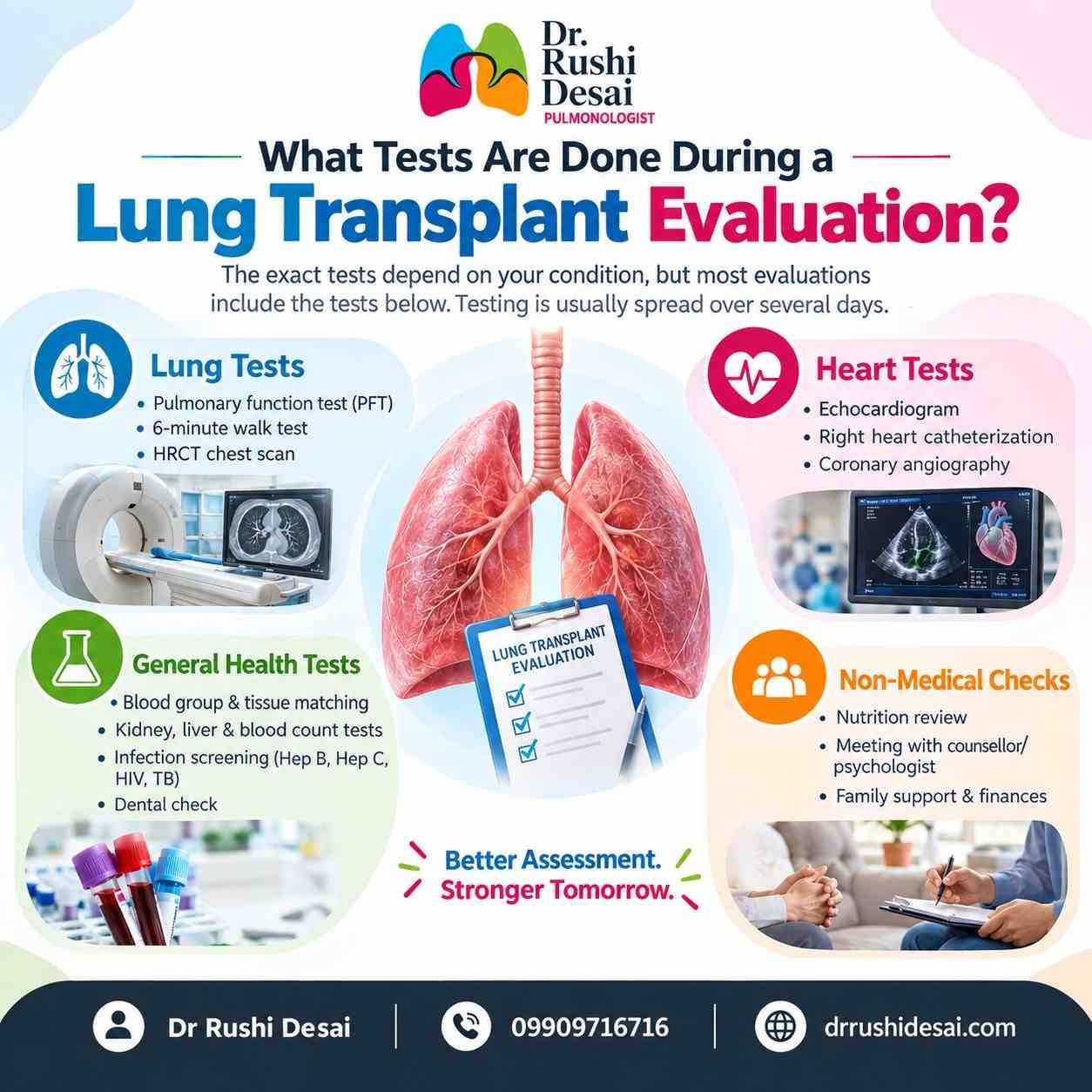
The exact list depends on your condition, but most evaluations include the tests below. Testing is usually spread over several days.
Lung tests
- Pulmonary function test (PFT) to measure how much air you can move
- A 6-minute walk test to see how far you can walk and how low your oxygen falls
- HRCT chest scan to map the damage in detail
Heart tests
- Echocardiogram to check heart function and lung artery pressure
- Right heart catheterization in some patients, mainly pulmonary hypertension
- Coronary angiography in older patients or those with heart risk factors
General health tests
- Blood group and tissue matching
- Kidney, liver and blood count tests
- Screening for infections such as hepatitis B, hepatitis C, HIV and TB
- Dental check, since mouth infections can become a problem after transplant
Non-medical checks
- A nutrition review, because being very underweight or overweight can affect outcomes
- A meeting with a counsellor or psychologist
- A talk about your family support and finances
Cost is one of the first things families ask about. We cover it in our guide to the cost of lung transplant in Ahmedabad, including how single and double transplant differ.
Who Is a Good Candidate, and Who May Not Be?
Every transplant centre sets its own rules, but the usual checks are similar. You are more likely to qualify if you:
- Have advanced lung disease that is not improving with treatment
- Are not smoking and have not smoked for a stretch of time
- Have no active cancer or uncontrolled infection
- Have heart, kidney and liver function good enough for major surgery
- Have a caregiver who can stay with you after surgery
- Can take medicines on time for life
Age matters, but it is not a simple cut-off. A fit 60-year-old may qualify while a frail younger patient may not. This is why we look at the whole person and not just the scan.
Some conditions can make transplant unsafe or less effective. These include recent cancer, serious liver or kidney failure, and active uncontrolled infection. If one of these applies to you, we explain the reasons and plan other treatment, such as oxygen, medicines and pulmonary rehabilitation.
How Does Dr. Rushi Desai Guide You Through the Process?
Many patients tell us the hardest part is not knowing what comes next. Dr. Rushi Desai works with patients from the first consultation through the evaluation. He explains each result in plain language and helps you understand where you stand.
If you are accepted, you are registered through the official organ allocation system, and your care continues while you wait. If you are not yet ready, we set a plan to review you again.
You will also face a choice about the type of surgery. Our guide to single vs double lung transplant explains how that decision is made.
What Happens After the Evaluation?
There are three common outcomes:
- Ready for listing. You are registered and followed closely while you wait for a suitable donor.
- Not yet. You continue treatment, and we repeat key tests at agreed intervals.
- Not a candidate. We focus on keeping you comfortable, active and out of hospital.
A transplant is not a cure with no strings attached. It brings lifelong medicines, regular follow-ups and a risk of rejection and infection. For the right patient, though, it can bring back far more breath and independence than medicines alone. Outcomes vary with your disease, age and overall health.
Conclusion
If advanced lung disease is limiting your life, a transplant evaluation is the clearest way to learn whether this path is open to you. It gives you facts about your lungs, your options and the next step, whatever the answer turns out to be.
Ready to talk to a lung transplant doctor in Ahmedabad?
Contact us to book your consultation with Dr. Rushi Desai. If you would rather start with a message, you can chat with us on WhatsApp and share your reports. We will tell you what to bring and what to expect.
Frequently Asked Questions
Q: Does a transplant evaluation mean I will get a transplant?
A: No. An evaluation is a check of whether a transplant is safe and helpful for you. Some patients are listed, some are asked to wait, and some are advised against it.
Q: How long does a lung transplant evaluation take?
A: It varies. The tests can often be done over several days, but waiting for results and specialist reviews can stretch the full process to a few weeks.
Q: Can I be evaluated if I used to smoke?
A: Often yes, if you have stopped and stayed off tobacco. Centres usually require a period of being smoke-free. We will tell you what applies in your case.
Q: Is lung transplant only for older people?
A: No. Age is one factor among many. Your general fitness, heart, kidney and liver health matter at least as much.
Q: What if I am told I am not a candidate?
A: That is difficult to hear, but it is not the end of care. Oxygen therapy, rehabilitation and medicines can still improve comfort and daily life.
Medical note: This article is for general information only. It is not medical advice and does not replace a consultation with your doctor. Eligibility for lung transplant and treatment outcomes differ from person to person.