
By Dr. Rushi Desai, Pulmonologist & Lung Transplant Specialist, Ahmedabad
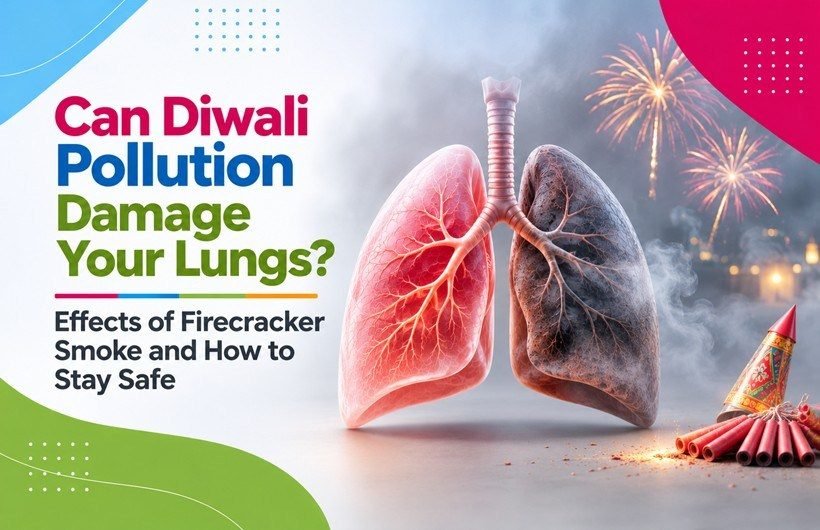
Yes, Diwali pollution can damage your lungs, and the harm can begin within hours of breathing firecracker smoke. The tiny particles and toxic gases inflame your airways, trigger Diwali pollution and asthma attacks, and leave many people coughing for days.
Every November, we see a wave of patients as a pulmonologist in Ahmedabad who say, “I was fine before Diwali.” This guide, written by Dr. Rushi Desai, a lung transplant specialist in Ahmedabad, explains what happens inside your chest and what you can do about it.
What Does Diwali Pollution Do to Your Lungs?
Firecracker smoke irritates and swells the lining of your airways. This makes breathing harder, sets off coughing and wheezing, and can cause infections. People with asthma, COPD or heart disease feel it first and worst.
The common effects of Diwali pollution on lungs include:
- Cough that is dry, irritating or lasts many days
- Wheezing and chest tightness
- Shortness of breath, even while walking slowly
- Burning throat, eyes and nose
- Asthma and COPD flare-ups
- Higher risk of chest infections such as bronchitis and pneumonia
What Is Actually in Firecracker Smoke?
Firecracker smoke is not just “smoke.” It is a mix of fine dust and gases, and each one affects the lungs differently.
- PM2.5: Particles about 30 times thinner than a human hair. They travel deep into the small airways.
- Nitrogen dioxide and sulphur dioxide: Gases that irritate the airway lining. The Central Pollution Control Board (CPCB) notes that nitrogen dioxide reaches the smaller airways of the lungs.
- Carbon monoxide: A gas that reduces how much oxygen your blood can carry.
- Metal particles: Compounds such as copper, barium and strontium are used to create firework colours, and they end up in the air you breathe.
How strong is the exposure? A study from the Chest Research Foundation, Pune, published in Lung India, measured PM2.5 near six common Indian firecrackers. Snake tablets reached a peak of about 64,500 µg/m³. India’s 24-hour safe limit for PM2.5 is 60 µg/m³.
Why Does Ahmedabad’s Air Feel Worse After Diwali?
Diwali falls when winter begins. Nights turn cooler, and the air near the ground moves less.
That means smoke from crackers settles over our neighbourhoods instead of rising and clearing. In my clinic, as a lung transplant specialist in Ahmedabad, I often hear that the worst breathing trouble is not on Diwali night. It is the next morning, when the haze is thickest.
Add vehicle exhaust and dust, and the day after Diwali can sit far above the WHO’s 24-hour PM2.5 guideline of 15 µg/m³.
How Does Diwali Pollution Damage Your Lungs?
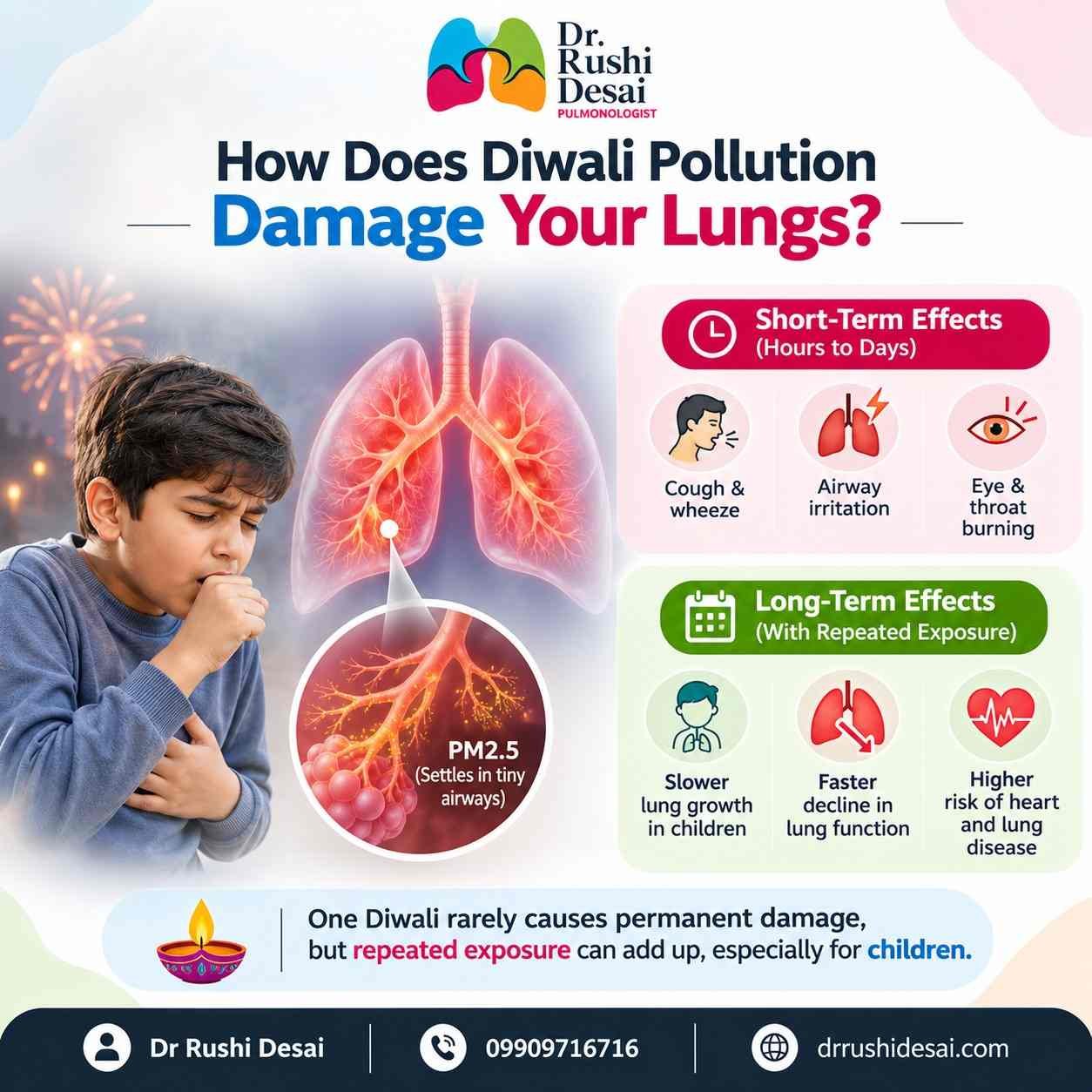
Think of your airways as a tree. The trunk is wide, but the tiny twigs at the end are very thin. PM2.5 slips past the trunk and lands in those twigs.
Your body treats these particles like invaders. The lining swells, mucus increases and the airways narrow. Researchers call this oxidative stress, a chemical injury to lung cells.
Short-term effects (hours to days):
- Airway irritation and swelling
- Cough, wheeze and breathlessness
- Asthma attacks
- Eye, nose and throat burning
Long-term effects (with repeated exposure):
- Slower lung growth in children
- Faster decline in lung function
- Worsening of COPD and chronic bronchitis
- Higher risk of heart and lung disease
One Diwali will not usually cause permanent damage in a healthy adult. Years of heavy pollution, including Diwali, can add up, especially for children.
What Are the Signs of Breathing Problems After Diwali?
Mild symptoms often settle within a few days to a week. Watch for these signs:
- A cough that continues beyond two weeks
- Wheezing at night or early morning
- Needing your reliever inhaler more often than usual
- Breathlessness when you walk or climb stairs
- Frequent throat infections or fever with cough
Go to an emergency room right away if you have:
- Trouble speaking full sentences
- Blue or grey lips or fingertips
- Severe chest pain or a racing heartbeat
- An inhaler that gives no relief
| Group | Why they are at risk |
| Children | Their lungs are still growing and they breathe faster |
| People with asthma | Airways are already sensitive and react quickly |
| People with COPD | Little lung reserve, so smoke causes flare-ups |
| Older adults | Often have heart or lung disease together |
| Pregnant women | Pollution can affect both mother and baby |
| Outdoor workers | Longer exposure, such as traffic police and vendors |
Diwali Pollution and Asthma: What Should You Do?
Asthma is the condition we worry about most this week. Smoke can turn mild asthma into a serious attack in minutes.
- Keep taking your daily controller inhaler, even if you feel well
- Carry your reliever inhaler everywhere
- Follow your written asthma action plan
- Refill your medicines before the festival
- Stay away from areas where crackers are burning
- Tell family members which symptoms need urgent help
Do not stop or change medicines on your own. If your asthma has been uncontrolled, see a doctor before Diwali, not after.
How to Protect Your Lungs From Diwali Pollution
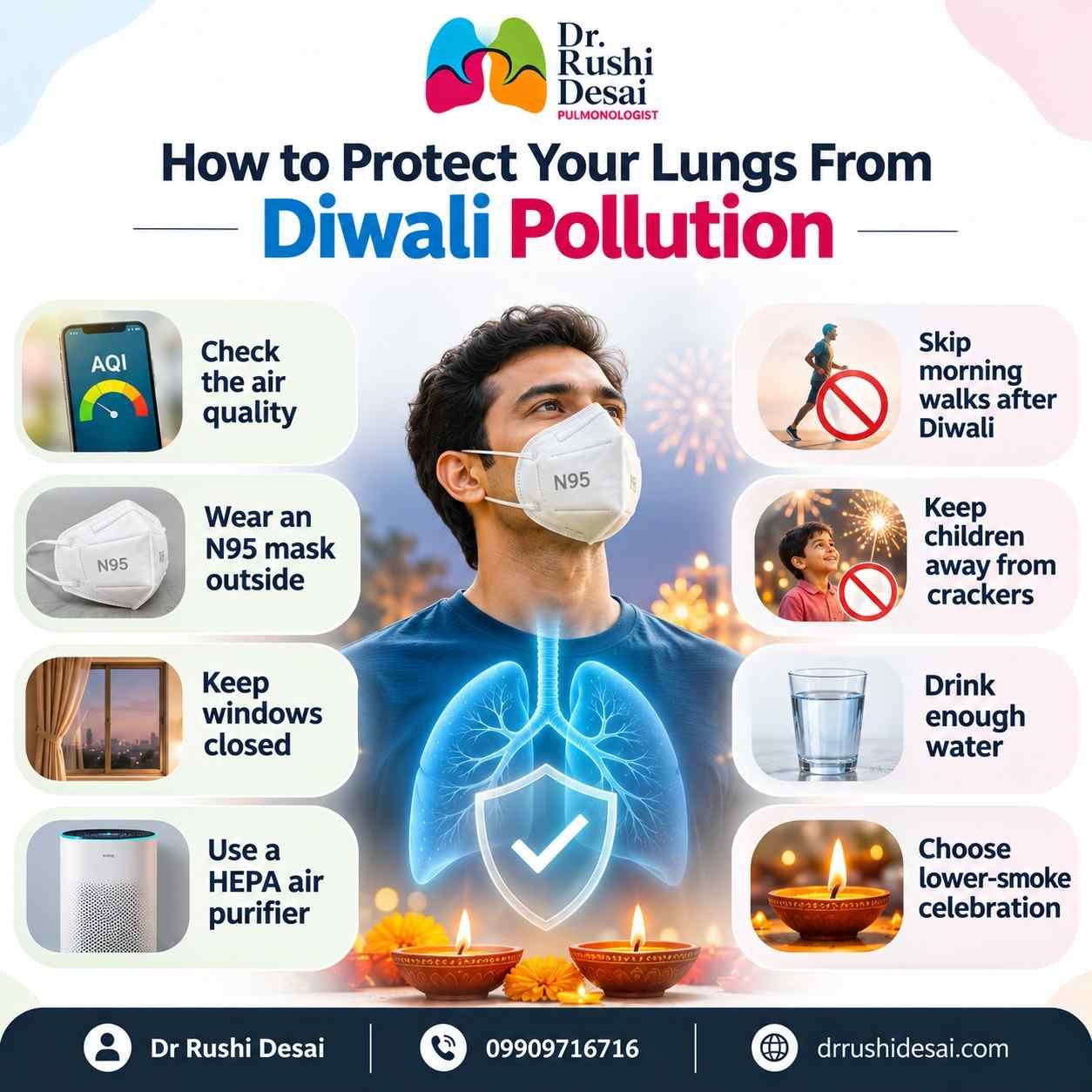
You do not need to hide indoors for a week. A few steps make a real difference.
- Check the air quality. Use a trusted AQI app. Avoid outdoor exercise when the AQI is poor.
- Wear an N95 mask outside. Cloth and surgical masks do not filter PM2.5 well. Make sure the N95 fits snugly.
- Close windows in the evening and early morning. This is when smoke is densest.
- Use a HEPA air purifier in the bedroom if you can.
- Skip morning walks the day after Diwali. Smoke is still low and thick near the ground.
- Keep children away from crackers. Never let them stand close to burning fireworks.
- Drink enough water. Hydration helps keep airway mucus thin.
- Choose lower-smoke celebration. Diyas, rangoli, lights and sweets cost your lungs nothing. “Green” crackers reduce emissions but do not remove them.
How Do We Treat Breathing Problems After Diwali?
Treatment depends on what is causing your symptoms. Dr. Rushi Desai starts with your history, a chest examination and, if needed, a lung function test called spirometry. This shows how well your airways are working.
Based on the findings, treatment may include:
- Inhalers to open and calm the airways
- Nebulisation during a flare-up
- Short courses of medicine for infections
- Chest X-ray if the cough lasts long
- A long-term plan if asthma or COPD is found
Honest note: medicines can control symptoms well in most patients, but results depend on how severe the disease is and how early you seek help. A cough that will not go away should never be ignored.
Most people recover with simple care. A small number with advanced lung damage, such as end-stage COPD, may need to be assessed for a transplant.
If a transplant is ever advised, understanding single vs double lung transplant helps you ask the right questions.
Conclusion
Diwali pollution can damage your lungs, but you can protect them. Check the air quality, wear an N95 mask, keep inhalers close and keep children away from crackers.
The effects of Diwali pollution on lungs are usually short-lived in healthy people, but for those with asthma, COPD or a long cough, they can be serious. If your breathing has felt different since Diwali, get it checked.
Worried about your breathing after Diwali?
Do not wait for it to pass. Contact us to book a lung check-up in Ahmedabad.
Frequently Asked Questions
Can Diwali smoke cause permanent lung damage?
A single Diwali rarely causes permanent damage in healthy adults. But repeated heavy exposure over many years can reduce lung function, especially in children and people with asthma or COPD.
How long do breathing problems last after Diwali?
Mild cough and throat irritation usually settle within a few days to a week. If symptoms last more than two weeks or keep getting worse, see a pulmonologist.
Is firecracker smoke worse than cigarette smoke?
They are different exposures. Firecrackers release very high PM2.5 for short bursts, while cigarettes cause steady exposure over years. Both harm the lungs, and firecracker smoke can be dangerous for people who already have lung disease.
Do N95 masks protect against Diwali pollution?
A well-fitted N95 mask filters most fine particles and is the best mask for firecracker smoke. It does not block gases completely, so staying away from smoke is still important.
Should I stop my asthma medicines during Diwali?
No. Keep taking your controller medicines as prescribed and carry your reliever inhaler. Smoke makes asthma worse, so this is when you need your treatment most.
Medical disclaimer: This article is for information only and is not medical advice. It does not replace an examination by a qualified doctor. If you have severe breathlessness or chest pain, go to the nearest emergency room.