
By Dr. Rushi Desai, Pulmonologist & Lung Transplant Specialist, Ahmedabad
You use your inhalers, carry oxygen, and still get breathless walking to the bathroom. At that point, many patients and families ask whether a lung transplant for COPD is an option. It can be, when the disease is end stage and medicines no longer control it.
If you want a pulmonologist in Ahmedabad to assess this, asking early keeps more of your options open.
Most people with COPD never need a transplant. For the few with advanced disease, though, the timing of referral matters a great deal.
| Quick answer: A lung transplant for COPD is considered when the disease keeps worsening despite the best treatment and the risk of death from lung disease over the next two years is high. Doctors use the BODE index, lung function (FEV1), flare-up history and oxygen levels to decide. Age alone does not rule you out, but it affects risk. |
When Is a Lung Transplant Needed for COPD? The Numbers Doctors Use
The International Society for Heart and Lung Transplantation (ISHLT) 2021 consensus guides most transplant centres. Its general rule is to consider transplant when the risk of death from the lung disease within two years is high. The patient must also have a good chance of doing well afterwards.
For COPD, doctors use the BODE index. It scores four things from 0 to 10:
- Body mass index
- Obstruction (FEV1 on spirometry)
- Dyspnea (breathlessness)
- Exercise capacity (six-minute walk distance)
Think of it as a report card for your whole health, not one lung-function number.
| Stage | What doctors look for |
| Referral (time for a transplant assessment) | BODE index of 5–6; FEV1 below about 25%; worsening despite maximum treatment; low blood oxygen or high carbon dioxide |
| Listing (time to join the waiting list) | BODE index of 7 or more; FEV1 below 15–20%; three or more severe flare-ups in a year; one severe flare-up with carbon dioxide retention; moderate-to-severe pulmonary hypertension |
What Is End Stage COPD, and Is Emphysema Treated Differently?
End stage COPD means your airways and lungs are so damaged that daily activity is severely limited. You may need oxygen at home, and flare-ups may put you in hospital again and again. Many people at this stage already use home oxygen therapy.
Emphysema is a type of COPD in which the air sacs are destroyed and air gets trapped. An emphysema lung transplant follows the same criteria as other end stage COPD lung transplant decisions. Some emphysema patients may first be assessed for lung volume reduction surgery or endoscopic valves, and ISHLT allows both to be assessed at the same time.
Who Qualifies for a Lung Transplant for COPD?
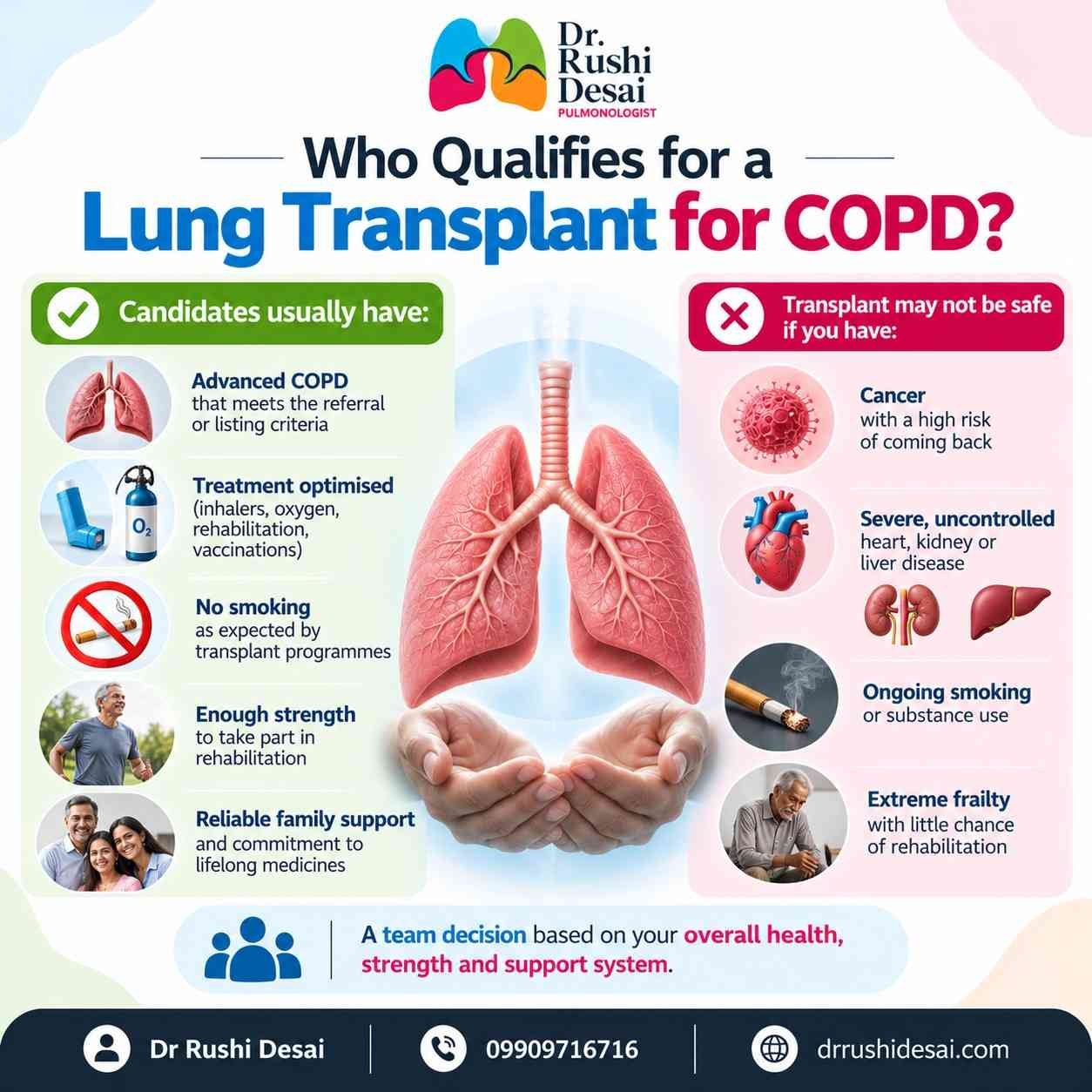
Candidates usually have:
- Advanced COPD that meets the referral or listing criteria above
- Treatment that has already been optimised (inhalers, oxygen, rehabilitation, vaccinations)
- No smoking, which transplant programmes expect
- Enough strength to take part in pre- and post-transplant rehabilitation
- Reliable family support and a commitment to lifelong medicines
Transplant may not be safe if you have:
- Cancer with a high risk of coming back
- Severe, uncontrolled heart, kidney or liver disease
- Ongoing smoking or substance use
- Extreme frailty with little chance of rehabilitation
These are weighed together, not one at a time. Pulmonary hypertension also matters because it can raise the urgency. If you want to understand it better, read about pulmonary hypertension and how it is diagnosed and treated.
COPD Lung Transplant Age: Is There a Cut-Off?
There is no fixed upper age limit. The 2021 ISHLT document treats age 65–70 as a risk factor and age above 70 as a higher-risk factor. Neither is an automatic “no.”
Practice is changing. Recent reports show that people aged 70 and older now make up around 13% of lung transplant recipients worldwide. One 10-year single-centre study found similar survival between recipients under 70 and those 70 or older.
What matters is your biological age, not your birthday. A fit 68-year-old may do better than a frail 58-year-old.
How Does Transplant Evaluation Work?
Evaluation looks at whether a transplant will help you live longer and breathe better. It usually includes:
- Lung function tests, a six-minute walk test and CT scans
- Heart tests and blood tests
- Kidney, liver and bone health checks
- Nutrition, physiotherapy and psychological assessment
Dr. Rushi Desai reviews your reports, explains where you stand, and tells you honestly if transplant is too early, appropriate, or not the right path.
What Results Can You Expect After a Lung Transplant for COPD?
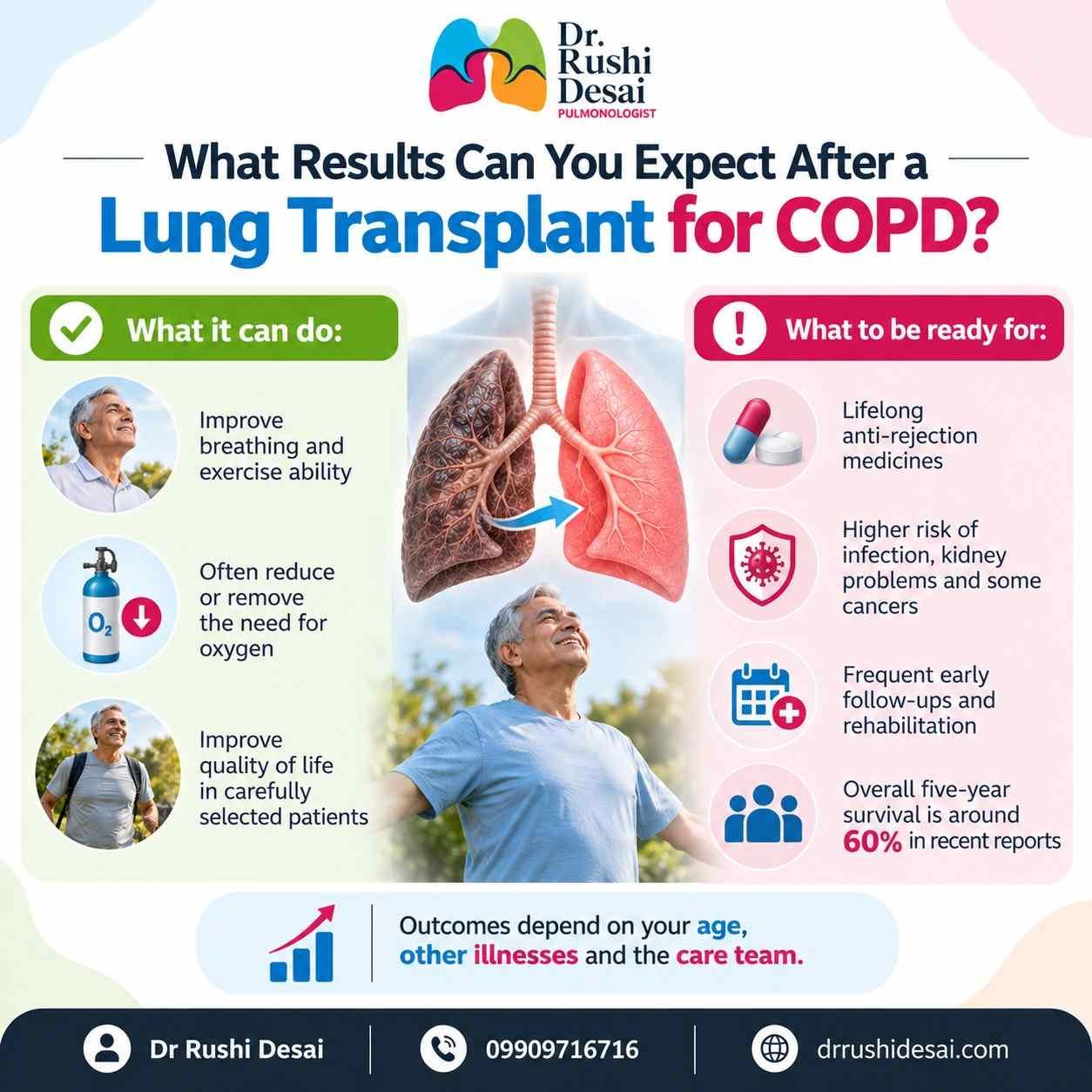
A transplant replaces the damaged lungs. It does not cure the underlying habits or exposures behind COPD, and it brings a new set of medical responsibilities.
What it can do:
- Improve breathing and exercise ability
- Often reduce or remove the need for oxygen
- Improve quality of life in carefully selected patients
What to be ready for:
- Lifelong anti-rejection medicines
- Higher risk of infection, kidney problems and some cancers
- Frequent early follow-ups and rehabilitation
- Survival that varies: overall five-year survival is around 60% in recent reports, and many COPD recipients are given bilateral (double) lung transplants
Outcomes depend on your age, other illnesses and the care team.
When Should You See a Lung Specialist? Warning Signs
Ahmedabad’s winter air and smoke or biomass exposure can make COPD flare-ups worse. See a specialist if you have:
- Breathlessness while dressing, eating or at rest
- Two or more flare-ups, or any hospital stay, in the past year
- A growing need for oxygen
- Unplanned weight loss with worsening breathlessness
- Morning headaches or drowsiness, which can signal high carbon dioxide
Conclusion
A lung transplant for COPD is not a first-line treatment, and it is not for everyone. It is an option for people with end stage disease who are strong enough to benefit. If breathlessness has taken over your days, it is worth finding out where you stand.
Ready to talk through your reports? Dr. Rushi Desai can assess your eligibility for a lung transplant for COPD. Book a visit or chat with us on WhatsApp and bring your latest test results.
Ready to talk to a lung transplant doctor in Ahmedabad?
Contact us to book your consultation with Dr. Rushi Desai. If you would rather start with a message, you can chat with us on WhatsApp and share your reports. We will tell you what to bring and what to expect.
Frequently Asked Questions
1. Can I get a lung transplant for COPD at 65 or older?
Yes, it is possible. ISHLT treats ages 65–70 as a risk factor, not a ban. Your overall fitness, heart health and strength decide your candidacy.
2. Is a lung transplant possible for emphysema if I still smoke?
In general, no. Transplant programmes expect you to have stopped smoking, because smoking raises the risk of complications and graft damage. Getting support to quit is the first step.
3. How long can someone live with end stage COPD without a transplant?
It varies widely. In the original BODE study, people with a score of 7 or higher had a median survival of about 37 months. Today’s treatments and individual factors can change this.
4. Does a lung transplant cure COPD?
It replaces the damaged lungs, so COPD does not come back in the new lungs. But you will need lifelong medicines and monitoring, and transplant carries its own risks.
5. When should I ask my doctor about transplant?
Ask when your disease worsens despite the best treatment, you are hospitalised repeatedly, or your BODE index reaches 5–6. Early referral gives you time to be assessed properly.
Medical Safety Note: This article is for general information only and is not medical advice. Eligibility for a transplant is decided case by case after full evaluation. Please consult a qualified pulmonologist about your own health.