

Medically reviewed by Dr. Rushi Desai, MBBS, MD (Respiratory Medicine), DM (Pulmonary Medicine). Last updated on 20/11/2026.
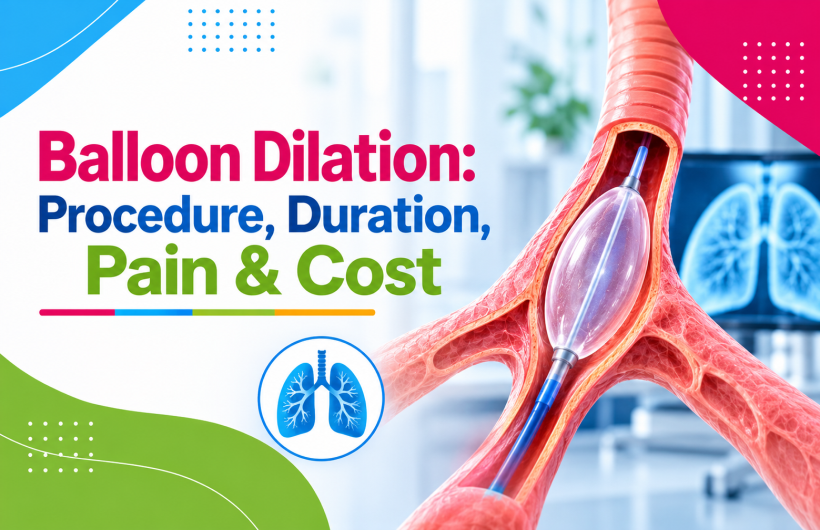
Balloon dilation uses a small balloon to widen a narrowed airway. A bronchoscope carries it to the tight spot, where it is inflated briefly and removed. It can ease breathlessness caused by a narrowed windpipe or bronchus. Most people go home the same day. Relief is often quick, but it doesn’t last for everyone. Your lung specialist can tell you if it suits you.
Care with Dr. Rushi Desai
- Bronchoscopy and Airway Procedures
- Find a Doctor and Specialists
- Make an Appointment
- Get a Second Opinion
Contents: What Is Balloon Dilation? | Symptoms and Causes | Diagnosis and Tests | Management and Treatment | Outlook | Prevention
What Is Balloon Dilation?
A small balloon gently stretches open a narrowed section of the airway.
Balloon dilation is a procedure that widens a narrow passage using a small balloon on a thin tube (catheter). In the lungs, it treats airway narrowing. A pulmonologist guides the balloon through a bronchoscope, inflates it for a short time, then deflates and removes it.
Your windpipe (trachea) and its branches (bronchi) carry air to your lungs. When scar tissue or swelling narrows them, doctors call it tracheal stenosis or bronchial stenosis. Each breath then takes more effort. The balloon presses gently outward, so the airway opens wider, and it needs no cuts on your skin.
Balloon dilation is one tool among several. It’s often used for short, soft narrowings and can be repeated if needed. It isn’t right for every airway problem, so your doctor checks the cause first. At Dr. Rushi Desai’s clinic, it is part of interventional pulmonology care.
Types of balloon dilation
Doctors use balloon dilation in several parts of the body. Common types include:
- Tracheal balloon dilation: widens the windpipe after scarring, often following a long-term breathing tube.
- Bronchial balloon dilation: opens a narrowed airway branch, for example after tuberculosis or a lung transplant.
- Eustachian tube balloon dilation: opens the ear tube that balances pressure, and is done by ENT surgeons.
- Balloon sinus dilation: opens blocked sinus drainage openings.
- Esophageal dilation: stretches a narrowed food pipe.
- Balloon angioplasty: opens a narrowed artery.
This page covers the airway type, which lung specialists perform.
Symptoms and Causes
Scar tissue can slowly shrink the space air has to pass through.
Symptoms of airway narrowing
Symptoms could include:
- Shortness of breath that slowly gets worse
- Noisy, high-pitched breathing (stridor)
- Wheezing that doesn’t improve with asthma inhalers
- A cough that won’t go away
- Hoarseness
- Trouble breathing during exercise
- A tight feeling in your throat or chest
- Repeated chest infections
- A bluish tint to your lips or skin, which is an emergency
These signs can look like asthma or COPD. That’s why airway narrowing is sometimes missed for months.
What are the first signs of airway narrowing?
The first sign is often breathlessness on stairs or a brisk walk, or a whistling sound when you breathe in. It may start weeks or months after a hospital stay with a breathing tube. If you notice this, don’t wait for it to get worse, and ask your doctor to check your airway.
Causes of airway narrowing
Think of your airway as a water pipe. Over time, scale builds on the inside wall and leaves less room for water to flow. Scar tissue does the same thing inside your windpipe, and you feel it as effort with every breath.
The most common cause is injury from a breathing tube or tracheostomy, which can scar the lining. Tuberculosis, lung transplant surgery, radiation therapy and chest or neck injury can also narrow the airway. So can inflammatory diseases and growths such as lung cancer.
Risk factors
Time on a ventilator (breathing machine) is a major risk factor. Other risk factors include:
- Having a tracheostomy
- Having had tuberculosis
- Having had a lung transplant
- Having had radiation to the neck or chest
- Having an inflammatory or autoimmune condition
Diagnosis and Tests
Your provider will ask about your symptoms, past hospital stays and any breathing tubes. They’ll listen to your breathing. Tests then show where the narrowing is and how severe it is.
How doctors diagnose airway narrowing
These tests could include:
- Bronchoscopy: a thin camera looks inside your airway and measures the narrow part.
- CT scan: maps the length and position of the narrowing in your neck and chest.
- Pulmonary function test: shows how well air moves in and out of your lungs.
- Chest X-ray: checks for infection or other lung problems.
- Biopsy: checks tissue if a growth is suspected.
Who is a good candidate for balloon dilation?
Balloon dilation tends to suit you if you have:
- A short, soft narrowing, such as scarring after you had a breathing tube
- A narrowing seen on bronchoscopy that causes symptoms
- Breathlessness that limits daily life
- A narrowing after a lung transplant or tuberculosis
- Good enough health for sedation or anaesthesia
It may not suit you if you have a chest infection that needs clearing first, or a very long or hard narrowing. Your doctor may then suggest a stent, laser treatment or surgery instead.
Management and Treatment
How is balloon dilation done?
Treatment depends on the cause, length and location of the narrowing. Options could include:
- Steroid medicines: reduce swelling in your airway lining.
- Balloon dilation: stretches the narrow part open.
- Laser or cutting tools: remove thick scar tissue.
- Airway stent: a small tube that holds the airway open.
- Surgery: removes the narrowed section of the windpipe.
Before the day, you’ll be asked not to eat or drink for several hours, and your doctor will review your medicines. For balloon dilation, you’ll have sedation or anaesthesia. The doctor passes a rigid or flexible bronchoscope to the narrowing. A deflated balloon catheter is placed across it, then inflated for short spells. The doctor may repeat this several times to reach the right size. Then the balloon and scope come out.
How long does balloon dilation take?
Most balloon dilation sessions take about 30 to 45 minutes. The balloon is inflated only for short spells at a time. Your doctor may repeat the inflation to reach the right size.
Add time for sedation, monitoring and waking up. Your team will check your oxygen level and breathing before you leave. Most people go home the same day, though some stay longer so the team can watch their breathing. You may feel back to normal within a day or two.
Does balloon dilation hurt?
You shouldn’t feel pain during the procedure. Depending on your health and the narrowing, you’ll have general anaesthesia (asleep) or local numbing with sedation. You may cough a little, which is a normal reaction.
Afterwards, you may have a sore throat, a mild cough or a husky voice. These usually fade within about 48 hours. Tell your care team if your breathing gets harder.
How much does balloon dilation cost?
There’s no single price. Your cost depends on your hospital, your city and how complex your narrowing is. The main factors are:
- The hospital and room type
- General or local anaesthesia
- The balloon catheter and any other devices
- The number of sessions you need
- Tests before the procedure and your follow-up visits
- Extra treatment, such as a stent or laser
At AB Plus Hospital, Ahmedabad, the cost usually ranges from our counselor. Ask for a written estimate. Also check with your insurer before you book, because policies differ.
When should I see a healthcare provider?
See your provider if your breathlessness, noisy breathing or cough keeps getting worse. A quick check can rule out serious causes and bring you relief sooner. Don’t wait if you’ve had a breathing tube, TB or a transplant and notice new symptoms, and tell your doctor about any past breathing tube, even from years ago. Get emergency help right away for severe breathlessness, a bluish tint to your lips or noisy breathing at rest.
Care with Dr. Rushi Desai
- Bronchoscopy and Airway Procedures
- Find a Doctor and Specialists
- Make an Appointment
- Get a Second Opinion
Outlook
What can I expect after balloon dilation?
You’ll likely rest for the day and can return to normal activity within a day or two. You’ll have follow-up visits, and often a repeat bronchoscopy, to check that your airway hasn’t narrowed again. Risks are uncommon but could include:
- Sore throat or cough: usually settles in a day or two.
- Bleeding: a small amount of blood in your phlegm is possible.
- Swelling: can briefly narrow the airway again.
- Low oxygen: your team watches this closely during the procedure.
- Tracheal tear: the most serious risk, though it is uncommon.
- Narrowing coming back: some people need repeat treatment.
Call your provider if you have a fever, cough up more than a little blood, or find your breathing getting worse.
Does balloon dilation work?
Often yes, and relief can be quick. But it isn’t always permanent. You may stay clear after one session. Others need repeat dilation, a stent or surgery. It’s most often used on soft scars, such as those after a breathing tube.
NICE, the UK health guidance body, reviewed the evidence in 2022. It found the safety evidence adequate. For adults, evidence on how well it works is limited, and most studies were in children. It advises doing the procedure only in specialist centres with anaesthesia and intensive care support. Ask your doctor what you can expect in your own case.
Prevention
You can’t always prevent airway narrowing, especially after a life-saving breathing tube. You can catch problems early. Ways to reduce your risk include:
- Finishing your full TB treatment
- Reporting new noisy breathing after a hospital stay
- Keeping follow-up visits after a transplant or airway surgery
A note from Dr. Rushi Desai
Struggling to breathe is frightening. It can shrink your world, from stairs to sleep to conversation. Many people are told it is asthma for months before the real cause is found.
Balloon dilation can help, but it is one step in a plan. We will explain every option, take time to answer your questions, and never rush your decision. You can also read more on our blog.
Experts You Can Trust
Medically reviewed by Dr. Rushi Desai, MBBS, MD (Respiratory Medicine), DM (Pulmonary Medicine), Interventional Pulmonologist at AB Plus Hospital, Ahmedabad. Last updated on 20/11/2026. Learn about our editorial process.
References
Our articles are based on evidence-backed sources and reviewed by medical professionals for accuracy.
- Brigham and Women’s Hospital. Tracheal stenosis (https://www.brighamandwomens.org/surgery/otolaryngology/throat-and-neck/tracheal-stenosis). Accessed 20/11/2026.
- Cleveland Clinic Consult QD. Treating benign subglottic and tracheal stenosis: which endoscopic approach has better outcomes? (https://consultqd.clevelandclinic.org/treating-benign-subglottic-and-tracheal-stenosis-which-endoscopic-approach-has-better-outcomes). 12/01/2023. Accessed 20/11/2026.
- Gleneagles Hospitals India. Bronchoscopic tracheal balloon dilatation (https://www.gleneagleshospitals.co.in/procedures/bronchoscopic-tracheal-balloon-dilatation). Accessed 20/11/2026.
- Kim et al. Balloon bronchoplasty for the treatment of bronchial stenosis after lung transplantation. Korean J Radiol. 2023 (https://doi.org/10.3348/kjr.2022.0999). Accessed 20/11/2026.
- Liang W, Hu P, Guo W, et al. Appropriate treatment sessions of flexible bronchoscopic balloon dilation for patients with nonmalignant central airway stenosis (https://pmc.ncbi.nlm.nih.gov/articles/PMC6391544). Accessed 20/11/2026.
- Memorial Sloan Kettering Cancer Center. Treatment of tracheal stenosis (https://www.mskcc.org/cancer-care/adult/tracheal-diseases/treatment-tracheal-stenosis). Accessed 20/11/2026.
- MSD Manual Professional Version. Laryngotracheal stenosis (https://www.msdmanuals.com/professional/ear-nose-and-throat-disorders/laryngeal-disorders/laryngotracheal-stenosis). Accessed 20/11/2026.
- National Institute for Health and Care Excellence (NICE). Endoscopic balloon dilation for subglottic or tracheal stenosis, IPG719 (https://www.nice.org.uk/guidance/IPG719/chapter/1-Recommendations). Published 02/03/2022. Accessed 20/11/2026.
Care with Dr. Rushi Desai
If breathing has become hard work, you don’t have to manage it alone.
- Bronchoscopy and Airway Procedures
- Find a Doctor and Specialists
- Make an Appointment
- Get a Second Opinion
Medical disclaimer: This article is for general information and education. It does not replace a consultation, diagnosis or treatment from a qualified doctor. Every person’s health is different, so please speak with Dr. Rushi Desai or your own healthcare provider about your symptoms and treatment options. If you have a medical emergency, call your local emergency number or visit the nearest hospital right away.