
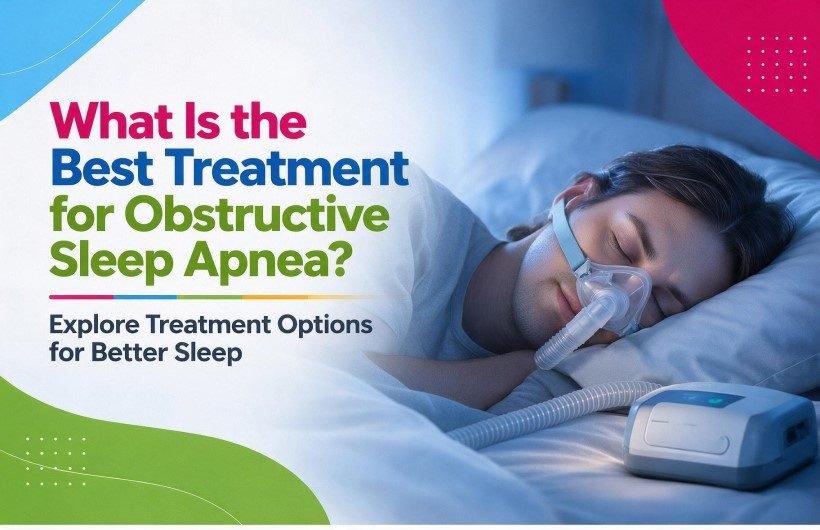
For most people with moderate to severe sleep apnea, the best treatment is CPAP (continuous positive airway pressure). It is the most proven option, and positive airway pressure therapy is the most common and effective treatment for obstructive sleep apnea. But the right choice depends on how severe your condition is, your weight, your throat anatomy and whether you can tolerate the device. If you are looking for obstructive sleep apnea treatment that fits your situation, a sleep-trained pulmonologist in Ahmedabad can help you choose.
Many of my patients come in after a partner says, “You stop breathing at night.” Others come because they wake up tired no matter how long they sleep. Both are good reasons to get tested.
How Severe Is Your Sleep Apnea? Why the Sleep Study Decides Everything
Treatment starts with a sleep study, either at home or in a sleep lab. It counts how many times per hour your breathing stops or becomes shallow. This number is called the AHI (apnea-hypopnea index).
- Mild: 5 to 14 events per hour
- Moderate: 15 to 29 events per hour
- Severe: 30 or more events per hour
Your AHI, your oxygen levels and your symptoms together guide the plan. Someone with an AHI of 8 who feels fine needs a different approach from someone with an AHI of 45 and high blood pressure.
Why CPAP Is Still the First Choice (and What to Do If You Hate It)
CPAP uses a mask and gentle air pressure to keep your throat open while you sleep. Think of it as a splint for your airway. It works the moment you use it, and it reduces snoring, daytime sleepiness and morning headaches.
The honest problem is that many people stop using it in the first few weeks. Most of the time the cause is a poor mask fit, a dry nose or too much pressure at the start. These can usually be fixed:
- Ask for a different mask style (nasal, nasal pillows or full-face).
- Use a heated humidifier.
- Use the “ramp” setting, which starts with low pressure and builds slowly.
- Give it at least 3 to 4 weeks, and aim for 4 or more hours a night.
In Ahmedabad, winter pollution and allergic nasal blockage make masks harder to tolerate. Treating the nose often fixes the CPAP problem.
Are Oral Devices and Position Changes Enough?
For mild to moderate sleep apnea, or for people who cannot use CPAP, a custom-made mandibular advancement device is an option. It looks like a sports mouthguard and moves your lower jaw slightly forward to open the airway. A dentist trained in sleep medicine should fit it. Side effects include jaw soreness and small changes in your bite.
Some people have apnea mainly when lying on their back. For them, sleeping on the side with a positional device can help. Your sleep study report shows whether this applies to you.
Can Weight Loss or Medicines Treat Sleep Apnea?
Weight loss can reduce apnea, and in mild cases it may resolve it. Even so, people at a healthy weight can have sleep apnea because of throat structure, so a medical evaluation matters either way.
There is also new evidence on medicines. In December 2024, the US FDA approved tirzepatide for moderate-to-severe OSA in adults with obesity, alongside diet and exercise. In the trials, people on tirzepatide had 27 to 30 fewer breathing events per hour, compared with 4 to 6 fewer on placebo, and they lost up to 20% of their body weight. Stomach side effects such as nausea and diarrhea were the most common problems.
There are limits here. The benefit is mainly due to weight loss, so it may fade if the medicine is stopped. This approval is a US decision, and whether it suits you is a decision to make with your doctor.
When Is Surgery or Nerve Stimulation Considered?
Surgery is rarely the first step. It is considered when CPAP and oral devices fail, or when a clear blockage is the cause. The options include:
- Tonsil or adenoid removal, which works well when these are enlarged.
- Nasal surgery, which mainly helps you tolerate CPAP rather than curing apnea.
- Hypoglossal nerve stimulation, an implant that moves the tongue forward during sleep. It is for carefully selected patients who cannot use CPAP.
- Jaw advancement surgery, a bigger operation for specific facial structures.
Results vary, and no surgery works for everyone. At our clinic, Dr. Rushi Desai reviews your sleep study results and your airway anatomy first. If surgery is on the table, we refer you to a trained ENT or maxillofacial surgeon.
Does Oxygen Alone Treat Sleep Apnea?
No. Sleep apnea is a blockage problem, not an oxygen supply problem. Extra oxygen can raise your blood oxygen number, but the airway still closes and your sleep is still broken up. Home oxygen therapy is useful for certain lung conditions, and sometimes alongside CPAP, but it does not replace it for OSA.
Why Treating Sleep Apnea Protects Your Heart and Lungs
Untreated sleep apnea is linked to high blood pressure, irregular heart rhythms, type 2 diabetes and stroke. Repeated drops in oxygen can also strain the right side of the heart. In some people this contributes to pulmonary hypertension. Treating the apnea protects your health as well as your sleep.
Daily Habits That Help Whatever Treatment You Choose
- Avoid alcohol and sedatives in the evening, since they relax throat muscles further.
- Quit smoking, which inflames the airway.
- Eat dinner early, and avoid large heavy meals before bed.
- Try side sleeping.
When Should You See a Pulmonologist?
See a specialist if you have loud snoring with pauses in breathing, gasping at night, morning headaches, or daytime sleepiness that affects driving or work. Also get checked if you have high blood pressure that is hard to control.
Conclusion
The best obstructive sleep apnea treatment is the one you can use every night and that brings your breathing events down. For many people that is CPAP. For others it is an oral device, weight loss or, in selected cases, surgery. If tiredness or loud snoring has been affecting your days, getting a sleep study is the step that tells you what to do next. You can book an appointment for a sleep evaluation. If you prefer to ask a question first, you can chat with us on WhatsApp.
Worried about your breathing after Diwali?
Do not wait for it to pass. Contact us to book a lung check-up in Ahmedabad.
Frequently Asked Questions
Q: Is CPAP the only treatment for sleep apnea?
A: No. Oral devices, positional therapy, weight loss, medicines and surgery are all options. CPAP is the most reliable for moderate to severe cases, but the best plan depends on your sleep study results.
Q: Can sleep apnea be cured permanently?
A: Sometimes. Weight loss, or surgery for a clear blockage, can bring apnea down to a very low level. For many people it is a long-term condition that needs ongoing management, much like blood pressure.
Q: Can thin people get obstructive sleep apnea?
A: Yes. A narrow airway, a large tongue, enlarged tonsils or jaw shape can cause it even at a healthy weight.
Q: How long before CPAP starts working?
A: Many people feel more alert within a few days to two weeks. Getting used to the mask can take 3 to 4 weeks.
Q: Can I use a mouth guard from a pharmacy instead of a custom one?
A: A custom device made by a trained dentist is safer and more effective. Ready-made versions fit poorly and may cause jaw or tooth problems.
Medical note: This article is for information only and is not medical advice. Sleep apnea needs a proper diagnosis, and treatment results vary from person to person.